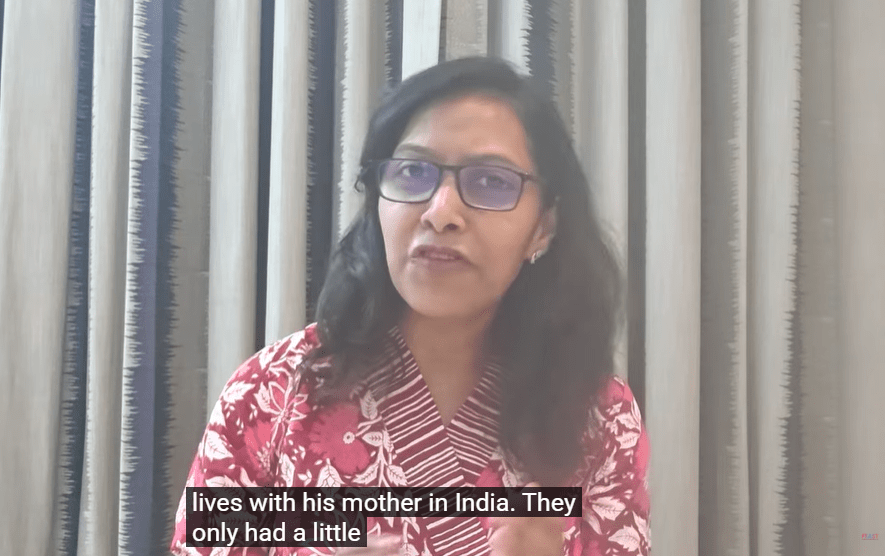
Storytelling in ‘The clever tailor’- Interview with Shilpa Mehta

Could you talk about the story summary? 

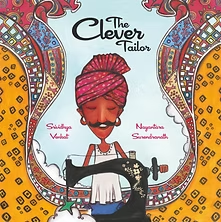
This is the story of the tailor Roopa Ram. It shows how creativity and care can transform scarcity into abundance. I see this as a powerful story on sustainability, resourcefulness and emotional values of simple things. He doesn’t have much, he is not a wealthy tailor. What is unique in the story is that Roopa Ram has the ability to make himself happy with what he has. When he gets the pagadi, it is to him more than a simple piece of cloth. Then this cloth changes from one form to the other. This remains a symbol of usefulness and continuity. Objects can have many lives when treated with care and concern – not only for children but also for adults. 


What are your reflections on the story? 

We are living in a world where we keep acquiring things and discarding them. In older times, people would repair things, reuse things and value their belongings. The story speaks against wastefulness and talks about sustainability.  

Everything Roopa Ram creates is for someone else in his family. The story revolves around affection and  thoughtfulness. Love can be experienced in each act of care rather than expensive gifts. 

You should not count if you have this and that. You should use whatever you have with you with your own imagination is what this story teaches us. 

Could you talk about converting an original English story into Hindi storytelling?

I made the story my own. It is set in Rajasthan and I tell the story in my mother tongue, which was all the more easy for me. The audience were government school children. I have made my own translation of the story. 

Can you talk about compassion in your storytelling? 

Whenever I tell, I tell with all my heart. If I am not able to connect with the story I don’t tell. When I tell a story with love and emotions, it comes out so easily. 

You have to believe in the story, and you have to believe in yourself. Otherwise you will not be able to connect with the audience. 

I have told stories on the autistic group Spectrum. Both were in Hindi. One has been a story within a story. The other story was about the acceptance of autistic children by people. In this story, an autistic boy is stopped from playing. The others feel he does not fit there. Then the boy is given colors and paints and everyone can see how brilliant his art is. The story ends with people realising that because he is different he cannot be excluded from playing. I had sent my script to my organiser. I told her, ‘you refine the language’. I wrote autistic child, she wrote neurodivergent. 

If you are telling an audience, you have to be able to connect with them. When I am not ready, I don’t tell stories. When it doesn’t come from the heart – I don’t tell stories. In Rivers of India by Spectrum – the awareness project, I tell stories of sisters who become a lake in Meghalaya. 

Why is it important to be able to know and connect with your audience? 

If a storyteller does not believe in a set of audience, say is not comfortable with children aged 4-6 and will get irritated if they run around, they should not do the session. You should be connected with your audience. 

My experience with children is that when I am able to tell stories, they become attentive. They usually come up with what they understood or what they take away with the story. Generally they use gestures to show you they care – it can be a smile, a nod of the head, any favourable movement. These tell me that we are on the same page. That is how I feel and connect with the audience. 

You do have nonverbal communication also. A small tear, here and there, if there is an emotional connect. Sometimes, when the session gets over, I let them talk. People don’t need advise. They need an ear to listen to things bottled within them. 

I bought Kahani Thela to Jaipur through the Delhi Storytellers Tribe for the first time. I went to an NGO that is for girls under 16 whose parents have died of AIDS. 

I could feel my heart. I was wondering if I would be able to or not tell a story for them. They were struck with wonder – ‘who has come to tell us a story?’ 

For me it was a learning. For them it made a world of difference. Next year, I went to the same place. Most of them remembered me. 

Could you talk about body language and other storytelling techniques? 

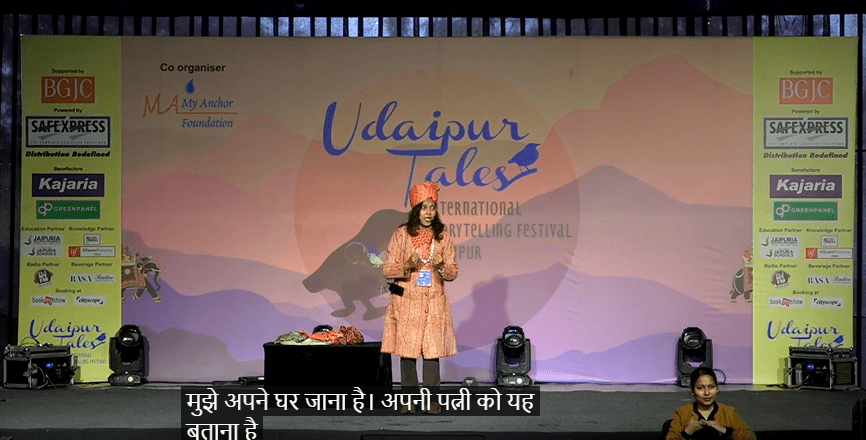
When I was performing in stage, there is a wide scope of storytelling techniques with props, body language, gesture and movement. The body language I used for Roopa Ram, the tailor included how Roopa Ram was standing, how he was carefully working on the oodani for his wife. His open energetic posture. When the tailor goes home – gentle and loving body language. My movement was heavy to create dynamic walk movements, carrying things very proudly. I had used repetitive stage actions. Gestures was another element. I used my hands for every gesture. I showed with my arms ‘It became smaller and smaller’ – all the gestures made the audience visualise the story. 

Through facial expressions, we can add emotional expressions. 

I used singing, “Mera Naam Roopa Ram..” Everyone showed surprise and delight when I sang that song. I used voice modulation e.g. softening the voice to show family love.  All this made the story very visually powerful. It helped the audience see the story very clearly. 

Could you talk about connecting to audience with familiar language?

I frequently connect to the audience with dialogues they know. Like the Mahabharata dialogue ‘Main Samay Hoon’ I changed it in a story to say ‘Main samaya hoon. Main Konark temple hoon.” 

I frequently use the la la la la from kuch kuch hoota hai. I have been often complemented for doing humorous work e.g. in the Gatha Festival. 

Story Reference for further reading 

YouTube> Shilpa Mehta | Performance 2025| 6th edition

The book
Storytelling in ‘The boy who wanted the drum’ – Interview with Shilpa Mehta

Could you talk about the story “The Boy Who Wanted the Drum?

There was a boy who wanted the drum. But, he did not get it immediately.  He walks on a path that leads to his dream.  His mother did want to get him a drum, but could not afford it. So, she got him a stick. He did not get angry. He continued to find joy in simple things. He was content. Contentment is a rare and beautiful quality these days. 

The mother wanted to get the boy the drum. That is love. Love is thinking of someone when we have very little for ourselves. 

The boy takes the stick. But he keeps giving to the woman, hungry child, washerman, robbed man and groom’s father at the wedding. He gave everything he had – the stick, the chappatis, the clay pot, the shawl, the horse and the drum. This story is a reminder that giving does not make us poor. The real magic was in the boy’s kindness, gratitude and his desire to help others, when he himself had very little. 

When the boy asks for another stick, he understands the secret of life – what we give in love never leaves us. It returns in many ways and in other beautiful ways which we can’t imagine. 

Could you talk about rhythm and repetition in your storytelling of ‘The Boy Who Wanted a Drum’?

I added rhythm and repetition to engage the audience. Rhythm and Repetition – that is the difference between reading and telling. When you read, they are simple sentences. When I tell, I use repetition to make the story more energetic.

How do you select your stories for storytelling?

For each story I want to tell, I read it many times. I work to make the listeners part of the story. Then I use imagery and add emotions at important points. I set the style to create imagination like “bright chillis”, “hot dusty road” in the story “The Boy Who Wanted the Drum.”  I use such images. When a story stays with me, I call it a sticky story. I write it down. I try to rewrite the whole story to make it a tellable form. I use musical instruments and Bollywood songs so that the audience connects to the story.

I use voice modulation to make characters and images come alive. I change pitch, volume and sound. Voice modulation is one of the tools of storytelling. 

Like in this story, I used a very soft tired voice for the mother. I used a high-energy voice for the boy to depict his innocence and concern for all. I used voice modulation to depict the drum movements. 

Voice modulation helps differentiate between characters. It helps audiences of all ages pay attention. It creates the emotional movement in the story. 

I am the Reading Champion for Pratham Books’ under their “One Day, One Story” campaign in Jaipur to celebrate International Literacy Day in September. Every year, two picture books are allotted. 

I rewrite the stories again, adding dialogues, music to make it more interactive and engaging with the children and turn them into a tellable form. Reading is different from telling. And telling is different from performing. 

While performing the Chinese folktale “Tikki Tikki Tembo”, I make my telling interactive by stepping down from the stage and inviting a child from the audience to enact a scene with me. The moment I do this, the energy in the room changes completely. Children eagerly raise their hands, hoping to be chosen. This participation creates excitement, curiosity, and a sense of belonging. Also, performing on the stage allows the use of a lot of props.

Could you talk about the time limit in performances?

The time limit is very important in storytelling performances because it helps maintain the energy, attention, and impact of the story. 

While performing The Boy Who Wanted a Drum, the performance had a limit of eight minutes, so I had to carefully choose which details to keep and which to shorten. For example, I could not elaborate much on scenes like the mother picking the chillies, drying them, and pounding them into chilli powder, details that could have created rich sensory imagery through sounds, movements, smells, and textures. These moments would have added depth and atmosphere to the story, helping the audience visualise rural life more vividly.

However, because of the time constraint, I had to trim those portions and focus on the main narrative flow.

 The storyteller must balance interaction with the flow of the story so that the performance remains meaningful and impactful within the given duration.

 Not following the time limit, does not create a good impression.

It is important to practice within a time limit, and the key is to Practice, Practice, Practice. 

Storytelling is not only about telling a story beautifully. It is also about knowing what to leave out so that the story remains engaging, effective, and within the given time.

Respecting the time limit also shows professionalism and consideration for organisers, co-performers, and the audience. 

Could you talk about selecting stories that are an authentic lived experience?

That is very important. I don’t pick any story I do not believe in. The story should come from your heart. I read a lot. I choose to tell the stories that stay with me long after I have read them, and because they touch me personally, I can narrate them with greater authenticity and connection. The story should stay with the listener even after the performance ends. When I have selected the story, I see where I can build reflection, repetition, imagery and opportunities for interaction. 

Whatever I read is distilled into my telling. When I am telling, but I can’t go into the same lengths as the author in descriptions. 

Could you talk about Indian sounds in your telling?

The beat of the drum – dham thama thama dham 

The sounds of the village are brought to life. 

Humming popular bollywood songs tunes.

Do you use sounds from Bhartanatyam, Carnatic Music, Hindustani Music and other Indian traditions?

While performing live, I believe that music, movement, rhythm, and sound must resonate with the audience emotionally and culturally. I often use musical instruments, voice modulation, and familiar Bollywood tunes because they immediately create connection and participation among Indian audiences. 

At the same time, I adapt my performance according to the audience. Storytelling for Indian audiences and international audiences can be very different. For international listeners, I rely more on universal soundscapes and atmospheric sounds such as the wind blowing, storms rumbling, birds chirping, footsteps, silence, or flowing water.

For example, while narrating a moment like, “Then he went quiet and the wind went aahhhhhhhh…” I use vocal sound effects and pauses to create mood and sensory imagery.

This adaptability is an important part of storytelling. A storyteller must understand the cultural pulse of the audience and use music, movement, and sounds that resonate with them while still preserving the soul of the story.

Story Reference for further reading 

Youtube > 2025 May_Story in the Spotlight_The Boy Who Wanted a Drum by Shilpa Mehta

Murty, Sudha. The Magic Drum and Other Favourite Stories. Penguin Books India, 2006. 

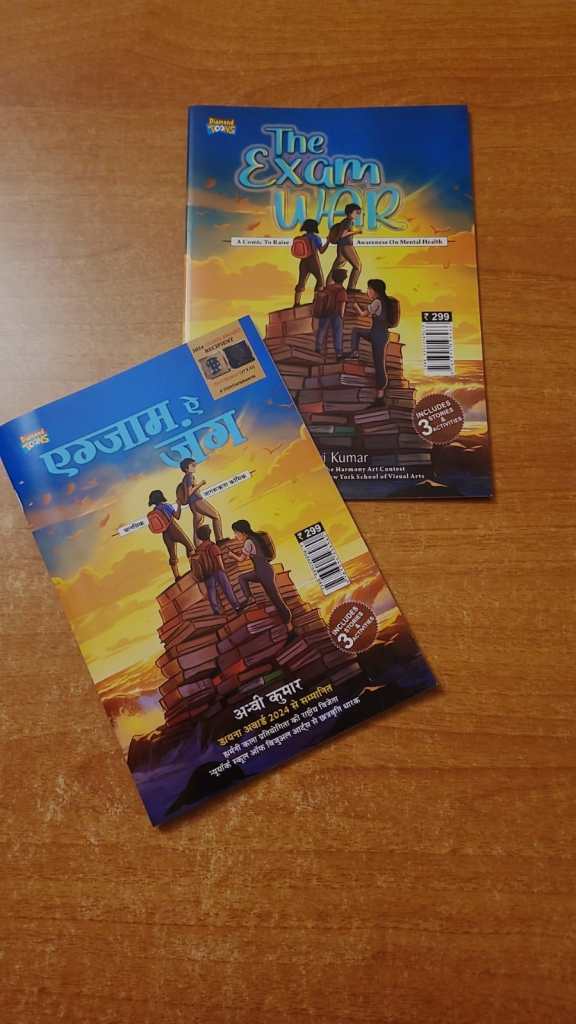
Book Review: The Exam War by Anvi Kumar

The Exam War is a comic book written by Anvi Kumar when she was an eleventh grader. The Exam War investigates what it takes for teenagers to go through a patch of exam preparations. Four teens and friends Krishh, Jahvi, Zahra and Hunar have different ways of fighting the same monster – an exam. This comic with unusual illustrations, done by the author who is also an award-winning artist, takes one through the mind of teens pre, during and post an exam. The Exam War is a useful support for students looking for resources in positive education to guide them through their study processes.

­­

“From timelessness to the field of time” – Interview with Dr. Chand Bharadwaj – Part 2

Could you elaborate on Attention Theory?

Creation is intelligent design, even a blade of grass is intelligently designed. There has to be an intelligent being who is doing it all – absolute intelligence in a capable force.

That intelligent being became from one to many. That was one of us. We are considering him as Kal, time, he asked for a boon and it was given. Only then, time starts.

Could you talk about how this pans out?

We are talking about CO-AIM Theory and Practice.

A – Attention

I – Information

M – Material

Co – Correlation

CO-AIM is correlating attention, information and material.

The attention is constant, while information and material are variables.

CO-AIM is a theory and practice. It is a philosophy. This attention is representing the holding of consciousness. Once you understand the words, ‘totality of consciousness’ it gives a wider spectrum. This is region we have talked about belongs to a region where time and material don’t exist.

Could you talk about attention?

The attention is continuously blinking on material issues of the world – related to time and material of this body in which we are, going out downward and outwards into the world through the senses of the body, from the timeless zone to the domain of time – one of us created time, the other created the material. In my system, this is known as Kal created Maya.

Time begins – one of us Kal starts creating.

Higgs boson, originally called the God Damn particle, when the intelligent behaviour of the particle was seen, corelating the creative intelligence as one of the parts of the absolute, fragmented from one to many.

From timelessness to the field of time.

We are now seeing this creative intelligence creating time and material as Higgs Boson explained by CERN in Switzerland as the God damn particle. The publisher asks to remove the word damn and it was known as the god particle. The book was published and it was a success. The ability of this Higgs Boson (god particle) is the ability to attract which is related to gravitation and magnetic energy.

On the nature of creation?

Two items were attracted together-electron and proton and created the first atom as Hydrogen. This is the postulate of the philosophy. It is allowed to have a postulate. It has to be approved by the philosophers.

Then two hydrogen atoms were attracted to create that one at helium. By attracting further hydrogen and helium together, it created that galaxy of suns burning hydrogen and helium. And in the scriptures of mine the knowledge was first given to the sun god. The suns were created first. They said the knowledge was first given to the sun god. This phenomenon was converted into a story explaining the sun god and the first knowledge was given to the sun god. To prove this phenomenon, we could know through scientific study of the cosmos at 22 places now. Two suns are creating the remaining elements which are 100 and odd.

The essence of Attention Theory – Interview with Dr. Chand Bharadwaj – Part 1

Could you talk about Attention Theory?

How it really all starts. Attention is the outer expressing of the creative intelligence. that remains connected to its source known as absolute intelligence in a capable force which is the totality of consciousness, all knowing, all pervading. That is the attention which remains connected to its source.

In Indian scriptures we call it Ek Aham Bahu Shyam. The god was one and alone and it was in bliss. In the stride of bliss. It felt like loving. And to love it became from one to many and the sound emerged. All those many are connected through this sound. Perennially connected to this sound.

What is this sound called?

Sabd

Anahat

It is called The Word in the Bible

It is called Kalma in the Koran

many words for it.

Bange Asmani is what the Koran called it.

Omniscient, omnipresent, this attention is representing the totality of consciousness.

Could you continue with the story of Attention Theory?

This is how it became from one to many. One part of this is known as Kal in my scriptures. Kal means time. The origin is in timelessness and the time starts now. One of us is known as time.

There is a story behind it. The story is like this – since it became from one to many. It asked for a boon to make a time bound material creation. As it is timeless, and it wanted to make a time bound material creation. We are creators. We are part of the absolute. He was given that boon to start. Here I punctuate with a sentence – it is a scientifically corroborated Indian Knowledge System correlating this phenomenon of attention with particle and wave theory in modern science. Attention is the outer expression of creative intelligence. Particle behaves intelligently in what science proved in a double slit experiment.

What was the double slit experiment?

The double slit experiment – if the particle applied is fixed with a single slit it forms a pattern at the background. If we put a double slit then the particle divides itself into two and passes through the double slit. The experiment further proved that it can become a wave or a particle, anytime, anywhere. And thus, the behaviour of the particle was evaluated as intelligent behaviour.

(To be continued…)

Sattva and the Storyteller – A photograph review of the Geeta Ramanujam’s storytelling performance: Krishna – The Last Walk

  • The nature of meaning in a performance
  • What is duality and what is Advaita?
  • The three conditions of Rasa
  • The traditions that inform

The nature of meaning in a performance

Meaning making in a performance needs story immersiveness and the ability to connect with the audience. To make a story your story you must live it and breathe it. And that is what Geeta Ramanujam does in this performance. The story of Krishna is also her story the story of the Bhakta. The leela of Krishna is enacted and embodied in an ancient traditional manner by the greatest living storyteller. Meaning making and the collective retentive memory of India is important to this performance. The memory of Sattvic stories, a collection of tales that connect us to the mystical and sacred selves, an understanding of the Atman and Paramatman.

What is duality and what is Advaita?

Geeta Ramanujam’s performance is on the nature of reality, the nature of duality of Prakriti which Krishna transcends through his playful maya-leelas. Advaita is the moral in all these traditional stories. But here Advaita is experienced, it is manifested through the act of a storyteller who is at once committed to the story and modes of storytelling. The jnana, the knower of the jnana and the enacter of the jnana become one in this splendid performance.

The three conditions of Rasa

Rasa and the discovery of delight in the performing arts is the subject matter of the Natyashastra. The three conditions of rasa are the oneness of audience, the story and experience of the story. The audience here is mesmerised by the calming and soothing performance that takes us to a world beyond the grasp of the mind and the senses. The story in itself is the timeless eternal story of Krishna. The experience of the story through the lens of Geeta Ramanujam’s serenity and wisdom.

The traditions that inform

Any performance needs a tradition, even if you are a contemporary performer there are traditions that inform you. The tradition that informs Geeta Ramanujam’s wise performance is that of the Indian Natyashastra. This tradition speaks of the need of creating rasa in the mind of the audience. She is also transmitting to us through this performance the great Bhagvata tradition. Indian storytelling has its roots in the HariKathas and this performance is also in the HariKatha tradition.

Building the Reading culture across India – Interview with Sheetal Shah, CEO & Founder Töölö and Töölö Library – Part 3

Could you talk about the goals of Töölö?

The goals are to build a neighbourhood library in the country. The goal is to build 1000 libraries in neighbourhoods across the country. Töölö started in Bangalore. The focus is on tier 2 and tier 3 cities. In tier 3 cities the acceptance of children in reading is faster and better. We have currently 50 libraries across the country. In the next few years, we hope to reach the 100 number much faster than we have been growing in the past 5 years.

Could you talk about the storytelling events organised by Töölö? How did you create the unique Toolo brand imprint?

Storytelling is an important aspect of the exposure to books, to make children love reading. Storytelling is a form of education for children. We have partnered with Kathalaya for many many storytellers. Storytelling for us, is where the brand is. We created the brand right at the very beginning and stuck to it. We created the brand platform by templating everything. The templates are replicated everywhere, creating consistency. We operate in a template model. That has been our modus operandi in many ways for branding.

Could you talk about your favourite Töölö storytelling?

All storytelling is special for me. Everytime with every storytelling, children’s eyes go wide, wider and widest. All storytellers are special – all of them.

Could you talk about your work in Preschools?

Along with the neighbourhood model, preschools is another focus area. We have noticed from the libraries that we are not able to convert non readers into readers. That is where the preschools come in. To create readers we have to start in preschools. In our work with preschoolers – we have a reader setting up the central library and also putting together the reading program. It makes a difference when you read to children regularly every day. Through reading and storytelling we started a program to help parents nurture readers at home. We also train teachers with helping children become readers in schools. Reading is a long and secluded journey. We built a rewards and recognition system. This is a three legged program we take to preschools

  1. Library – Setting up the library
  2. Programs for a. Children b. Parents c. Teachers
  3. Rewards and recognition program

Could you talk about your own journey while building Töölö?

It has been an exciting journey for me. It has been exciting to be part of this space. There has been a lot of learning for me. It is a supportive space.

On a personal note – I had been reading to my son since the very beginning, but for my daughter who was the second child I started reading late after 2 years. With regular reading, she started using long words and started by herself reading words from T-Shirts. She was featured in video using really complex words.

Sometime back, I had not been well and a friend came from Jaipur and started reading to me. I still hold on to special memories where we read aloud.

Books, Books and more Books – Interview with Sheetal Shah, CEO & Founder Töölö and Töölö Library – Part 2

Could you talk about your favourite books?

I used to read a lot – Enid Blyton, Roald Dahl etc. James and the Giant Peach by Roald Dahl taught me about the adventure and fun that existed in reading. With the authors that are there for children today, there are new worlds for children to explore. I love picture books, which are profound and relevant for adults.

Could you talk about your favourite picture book?

Gruffalo is my favourite. It is a popular book. Most people know about this book. Why I like the book is that it is a profound standpoint on how our fears are. We see little bits of the bigger picture. It is about turning our fears around. I think the storytelling in the book is interesting. The mouse is fed with looking at fears in the beginning. The more it decides to overcome the fear, that is what happens. The book teaches about how you can face fear head on. To realise that ‘I was scared at nothing’ keeps coming back to my own life. Gruffalo is an adventure story of profound meaning.

Spreading the joy of Reading – Interview with Sheetal Shah, CEO & Founder Töölö and Töölö Library – Part 1

Could you talk about your journey in Storytelling and as the Founder of Töölö?

My career in Töölö started 5 years ago. I was a voracious reader myself. When I had my first child I wanted him to help him become a reader. Books were encouraged at home and my son became a reader. When we moved to the United States my son was 7 years old and my daughter was three years old, they were both readers and liked being read to. We got exposure to public libraries in the United States. These public libraries made access to books super convenient and easy. My children were getting more motivation to read. When we moved back to India, this exposure to US libraries gave me the inspiration to build Töölö library. I wanted to give India a similar experience. I began Töölö Library by starting in my own apartment. It soon became a full-fledged revenue model.

Could you talk about the 2 Readalouds of children‘s picture books done by you in the Töölö Youtube Channel?

I do like to do readalouds myself. Have done readalouds for my own children. This is something I enjoy doing. Have been telling stories in schools for the marginalised. I love reading and do this a lot in Töölö and Töölö Library.

Could you talk about building India’s no. 1 cloud library?

There are a lot of libraries in India. After studying the library market in India, I do know that libraries spring up very quickly and they also disappear very quickly. I needed to build a model that will be scalable – to be able to build a library with what is available. The whole idea here is to use the capacity of books we have in our houses, to use our spaces in the house, the time of women who have the time but can’t be on a job etc. Could turn it into a model – to such capacity for our children who will be able to access and use it. It is a model for work from home where you can use the entire space in the home store the books and build a living.

Could you talk about your building a model to enable women to be entrepreneurs?

My own journey is that I took a break from the work force for my own children. Building such an entrepreneurial model for women was very close to my own heart. The goal is to help women build libraries and help them scale up sooner than later.

“Thinking Hearts and Storytelling Minds” – Interview with Tripat

Your career journey?

I started as an MBA aspirant and did an MBA with Marketing as the main subject and Finance as the minor subject. I was in the banking sector. I was doing well. However, it was not what I wanted to do. Banking was not filling my cup. We shifted from Mumbai to Ahmedabad. I was not travelling so much with the kid. I started Thinking Hearts. We would not contract with anyone. Ours is a nomadic brand. We would take our bag of stories with us and share the stories, one story at a time. I have seen the magic unfolded at that time. Someone in the audience is seeing opportunities and possibilities through the story. The audience can explore the world through stories – Korea, Japan etc,. If there is a white tiger in the story, they try to understand the white tiger. They try to see the real story. What is the real story in “Three for free” a Taiwanese tale about how a mountain was eaten. The story is about how the top half of the mountain was eaten by a group of greedy villagers when the mountain was offered as food by the Mountain deity. Such stories have different meaning for different people. The basic theme in this story is that there is nothing free in this world.

Could you talk about your organisation Thinking Hearts?

Thinking Hearts is inspired by my child’s uninhibited ability to express and identify what he would in the world. Recently I attended a theatre workshop by Micheal Chekov. During this workshop he talks about a quote, “Artists think with their hearts and feel with their minds.” From around the 1935 to 1945 a practitioner thought of the Thinking Hearts Philosophy. I had joined this workshop for learning movement, expressions etc, and found out about this older philosophy also called Thinking Hearts.

I just gave Thinking Hearts all I have. We don’t sign any contracts. We have done free workshops in Ahmedabad – NGO schools and kids events.

When I do a storytelling session the kid’s eyes just light up. They are following you like a CCTV camera. They just feel and take it all in. The moment that is most important, the aha moment – i do my best for that.

Could you talk about your storytelling mentors?

My mentors have been Geeta Ramanujam, Roger, Shiela Wee, Kiran Shah and Jeeva Raghunath.

I met Geeta Ramanujam two years in the Himalayas where she was doing a Storytelling Certification Course. I had heard a lot about her. In the first class she made a deep impression. She would mould herself to do something transformational. She has become an expert at this.

I met Roger when he visited Ahmedabad for 5 days – sharing stories and sharing how to deliver the stories to adults. It was a lot of soul food. I learnt how to connect with audiences.

Geeta Maam taught about different types of listening. She taught us about how audiences feel when they listen to a story. The heart becomes a part of the core.

I met Shiela Wee and Kiran Shah as a part of FEAST. They spoke about how to capture your story, expressions while telling a story, how you the storyteller can feel what the audience feels when they feel a story.

I am doing a mentorship with Jeeva Raghunath maam on storytelling for adults.

Could you talk about you being a mentor to your storytelling audience?

Every child comes from a different ecosystem. They all embrace different value systems, different ways of thinking. I can’t judge, I can’t mould. It is my duty to listen well. I listen to how their voice and language is changing after the story. The children do creative journalling. They do work around the story – Where the story came from? What book the story was originally from? If they can make a puppet or some prop with which they can share the story when they get home. How they see the story differently? We work together on story structure modules.

A child who has been silent through 8 sessions speaks up in the 9th session. The story in hand is of a mermaid being captured by a boat. So, the child speaks up and says put a tracking device on the mermaid. He was 5 years old and was not even able to say the words clearly. I asked him several times. Then we sat with him for three sessions to understand his perspectives on the stories and he had some much to share. My work is done.

Could you talk about your storytelling style?

My style is more participative. That’s why I attend theatre workshops too. I have learnt that even a little gesture matters. I usually end the sessions with hands on activities. In the story of the three dolls, I teach children about friendship. The Prince doesn’t know how to choose his friends. All children ask – Is she my friend? Is he my friend? Sometimes children feel left out in a group. The question was how to present such a story in front of children, I made mud dolls with the Kumhar, potter. I sat with him and made three distinct dolls with straw placed in the ear and the other end in a different location for each of the three dolls. The child can visualize which type of friend she or he wants –

One who hides all secrets

Or One who does not share knowledge with you

Or One who hears gossip about you and tells you instead of participating in this gossip

Where the straw is placed on the dolls helps the child visualize these scenarios. The question that is asked of the audience is – which doll do you want to be?

There is this story of a single grain of rice. A girl wins a bet with a Raja for getting a single grain of rice in front of five of the villagers. It is interesting how the story unfurls. The Raja agrees to double the rice, everyday for the next 30 days. On the 30th day, 56 elephants carry the rice into 4 storerooms. I had made 56 cut outs of elephants for this. By doubling the quantity of rice Brahma Bulls etc, are needed to carry the sacks of rice.

So the story goes –

32 Brahma Bulls carrying the rice.

56 elephants carrying the rice

Even a little child has some takeaway.

Could you talk about the distinguishing features of Indian stories, as compared to world folktales?

In Indian stories you find everyday life blending with the divine. There is a lot of complexity in Indian stories, moral complexity – ‘what is the truth?’ There is a lot of diversity – stories from Gujrat, Nagaland, Kerela – with different languages, different values. Food stories, different types of stories. There are a lot of sources for stories the Panchatantra, the Katha Sarit Sagara.

Could you talk about your personal favourite story?

I like the trickster spider tales – the Anasi stories. My personal favourite story is a Bantu story, “The story of the tree.” In this story, the animals get together when there is a famine and the winner is the underdog. The story speaks in 100 voices. There is wisdom and wonder.