
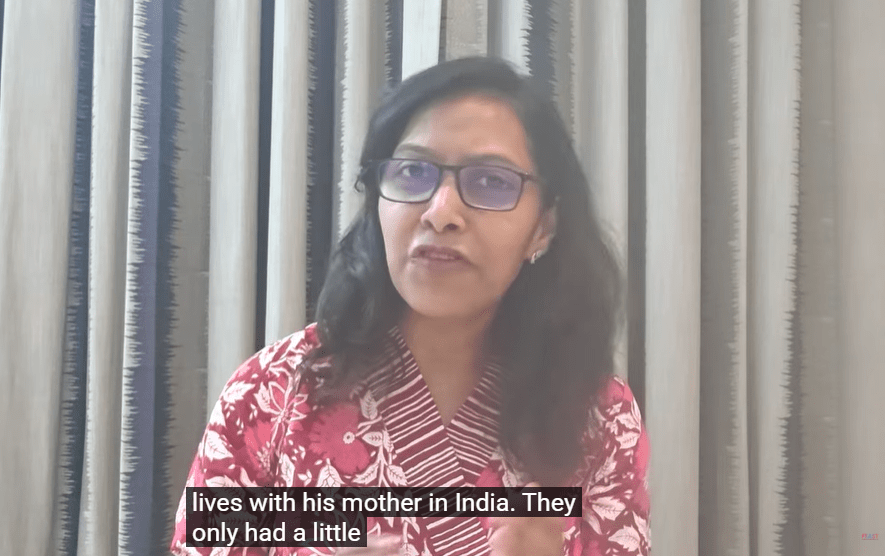
Could you talk about the story “The Boy Who Wanted the Drum?
There was a boy who wanted the drum. But, he did not get it immediately. He walks on a path that leads to his dream. His mother did want to get him a drum, but could not afford it. So, she got him a stick. He did not get angry. He continued to find joy in simple things. He was content. Contentment is a rare and beautiful quality these days.
The mother wanted to get the boy the drum. That is love. Love is thinking of someone when we have very little for ourselves.
The boy takes the stick. But he keeps giving to the woman, hungry child, washerman, robbed man and groom’s father at the wedding. He gave everything he had – the stick, the chappatis, the clay pot, the shawl, the horse and the drum. This story is a reminder that giving does not make us poor. The real magic was in the boy’s kindness, gratitude and his desire to help others, when he himself had very little.
When the boy asks for another stick, he understands the secret of life – what we give in love never leaves us. It returns in many ways and in other beautiful ways which we can’t imagine.
Could you talk about rhythm and repetition in your storytelling of ‘The Boy Who Wanted a Drum’?
I added rhythm and repetition to engage the audience. Rhythm and Repetition – that is the difference between reading and telling. When you read, they are simple sentences. When I tell, I use repetition to make the story more energetic.
How do you select your stories for storytelling?
For each story I want to tell, I read it many times. I work to make the listeners part of the story. Then I use imagery and add emotions at important points. I set the style to create imagination like “bright chillis”, “hot dusty road” in the story “The Boy Who Wanted the Drum.” I use such images. When a story stays with me, I call it a sticky story. I write it down. I try to rewrite the whole story to make it a tellable form. I use musical instruments and Bollywood songs so that the audience connects to the story.
I use voice modulation to make characters and images come alive. I change pitch, volume and sound. Voice modulation is one of the tools of storytelling.
Like in this story, I used a very soft tired voice for the mother. I used a high-energy voice for the boy to depict his innocence and concern for all. I used voice modulation to depict the drum movements.
Voice modulation helps differentiate between characters. It helps audiences of all ages pay attention. It creates the emotional movement in the story.
I am the Reading Champion for Pratham Books’ under their “One Day, One Story” campaign in Jaipur to celebrate International Literacy Day in September. Every year, two picture books are allotted.
I rewrite the stories again, adding dialogues, music to make it more interactive and engaging with the children and turn them into a tellable form. Reading is different from telling. And telling is different from performing.
While performing the Chinese folktale “Tikki Tikki Tembo”, I make my telling interactive by stepping down from the stage and inviting a child from the audience to enact a scene with me. The moment I do this, the energy in the room changes completely. Children eagerly raise their hands, hoping to be chosen. This participation creates excitement, curiosity, and a sense of belonging. Also, performing on the stage allows the use of a lot of props.
Could you talk about the time limit in performances?
The time limit is very important in storytelling performances because it helps maintain the energy, attention, and impact of the story.
While performing The Boy Who Wanted a Drum, the performance had a limit of eight minutes, so I had to carefully choose which details to keep and which to shorten. For example, I could not elaborate much on scenes like the mother picking the chillies, drying them, and pounding them into chilli powder, details that could have created rich sensory imagery through sounds, movements, smells, and textures. These moments would have added depth and atmosphere to the story, helping the audience visualise rural life more vividly.
However, because of the time constraint, I had to trim those portions and focus on the main narrative flow.
The storyteller must balance interaction with the flow of the story so that the performance remains meaningful and impactful within the given duration.
Not following the time limit, does not create a good impression.
It is important to practice within a time limit, and the key is to Practice, Practice, Practice.
Storytelling is not only about telling a story beautifully. It is also about knowing what to leave out so that the story remains engaging, effective, and within the given time.
Respecting the time limit also shows professionalism and consideration for organisers, co-performers, and the audience.
Could you talk about selecting stories that are an authentic lived experience?
That is very important. I don’t pick any story I do not believe in. The story should come from your heart. I read a lot. I choose to tell the stories that stay with me long after I have read them, and because they touch me personally, I can narrate them with greater authenticity and connection. The story should stay with the listener even after the performance ends. When I have selected the story, I see where I can build reflection, repetition, imagery and opportunities for interaction.
Whatever I read is distilled into my telling. When I am telling, but I can’t go into the same lengths as the author in descriptions.
Could you talk about Indian sounds in your telling?
The beat of the drum – dham thama thama dham
The sounds of the village are brought to life.
Humming popular bollywood songs tunes.
Do you use sounds from Bhartanatyam, Carnatic Music, Hindustani Music and other Indian traditions?
While performing live, I believe that music, movement, rhythm, and sound must resonate with the audience emotionally and culturally. I often use musical instruments, voice modulation, and familiar Bollywood tunes because they immediately create connection and participation among Indian audiences.
At the same time, I adapt my performance according to the audience. Storytelling for Indian audiences and international audiences can be very different. For international listeners, I rely more on universal soundscapes and atmospheric sounds such as the wind blowing, storms rumbling, birds chirping, footsteps, silence, or flowing water.
For example, while narrating a moment like, “Then he went quiet and the wind went aahhhhhhhh…” I use vocal sound effects and pauses to create mood and sensory imagery.
This adaptability is an important part of storytelling. A storyteller must understand the cultural pulse of the audience and use music, movement, and sounds that resonate with them while still preserving the soul of the story.
Story Reference for further reading
Youtube > 2025 May_Story in the Spotlight_The Boy Who Wanted a Drum by Shilpa Mehta
Murty, Sudha. The Magic Drum and Other Favourite Stories. Penguin Books India, 2006.


