Could you narrate any traditional story of Tamil Nadu?
This is a story on the origin of the Tamil language. It was time of Lord Shiva’s marriage to Parvathi in the Himalayas. There was so much crowd on Earth that all could not attend the wedding. Sage Agastyar was asked by Lord Shiva to go to the South with his wife Lopamudra. “Vindyas are growing very tall, you need to go to the South and stop the great height of the Vindyas. And take Tamil to the South of the Vindhyas.” And Shiva taught the sage the Tamil language. Agastyar did as he was told and left for the South with Lopamudra. When he came to the Vindhyas he told the mountains, “I am so short, How can I cross you over? You must bend down. And I will cross. And until I return this way you must remain bent.” The Vindhyas did as he bid. The Sage travelled to the South and taught people Tamil. In Papanasan near Thirunalveli there is an Agastyar temple where it is believed that Agastyar was able to see the wedding of Lord Shiva and Parvathy. He composed the Agastyam – a book which teaches all the grammar of Tamil. This text is lost today. One of the students of Agastyar wrote the available grammar book of Tamil – the Tolkpieyam.
Among the texts narrated by Sage Agastyar are the Lalitha Sahasranamam and Sri Cakra Raja Simhasineshwari.
Could you talk about the influence of Tamil culture on your storytelling?
For a modern storyteller there is so much to learn from Tamil Nadu. There are folktales from every region of Tamil Nadu. In Madurai, there are a lot of stories of Meenakshi and Lord Sundereshwarar. Each of these stories in celebrated in the Madurai Thiruvella in Chitirai.
There is this story of Meenakshi’s wedding. Lord Sundereshwarar comes to marry the Goddess. Her father died a few years ago. Lord Kalalgar, (Vishnu) wanted to give away his sister. But the river Vaigai was flooded. He was not able to cross the river. Vishnu as Koodalgar however attended the wedding. When Lord Kalalgar arrived the wedding was over, He was furious.
The biggest festival is in Madurai. Millions of people come to the temple on the full moon day of Chitirai.
Could you talk about your fondness for the traditional knowledge systems of India?
Most of the traditional knowledge which our elders know is dismissed as superstition. We can say karanam. There is a karanam for everything. That is the knowledge I want to take to children. Most children think that thier mothers and grandmothers did not know anything. Traditional knowledge is there with grandmothers and mothers passed on from generation to generation. Many children think that just because they got a degree their grandmothers don’t know anything.
Could you talk about the Tamil goddess Mariamman?
Mariamman is the rain goddess. Most villages have Mariamman or some kind of Amman. They act as goddesses of the fort – Elaiswamy. The thiruvala for Mariamman is in summer. In Chitirai. This is linked to a festival where people got vaccinated through needles. Vaidiyars will give antidote and needles will be administered.
During summer people would offer neem leaves and neer more for the Goddess. And they would offer turmeric to the Goddess.
Could you talk about the traditional folk dances of Tamil Nadu?
Mayil Attam – The peacock dance
Thapattam – People dance to the beats of one sided drum.
The Horse dance or Poi Kal Kudhiray Attam
Villupattu – The traditional storytelling of Tamil Nadu were the artists would half sing songs and half narrate the stories. This has a long history.
Bomaiattam – Where stories are narrated with puppets
Kargattam – The dancers keep a pot on top of the head and perform.
Therukuttu – A play is performed in the streets.
For folk forms like Thapattam and Poi Kal Kudhiray Attam there are still families that continue the tradition. 45-50 families perform and enact these traditions.
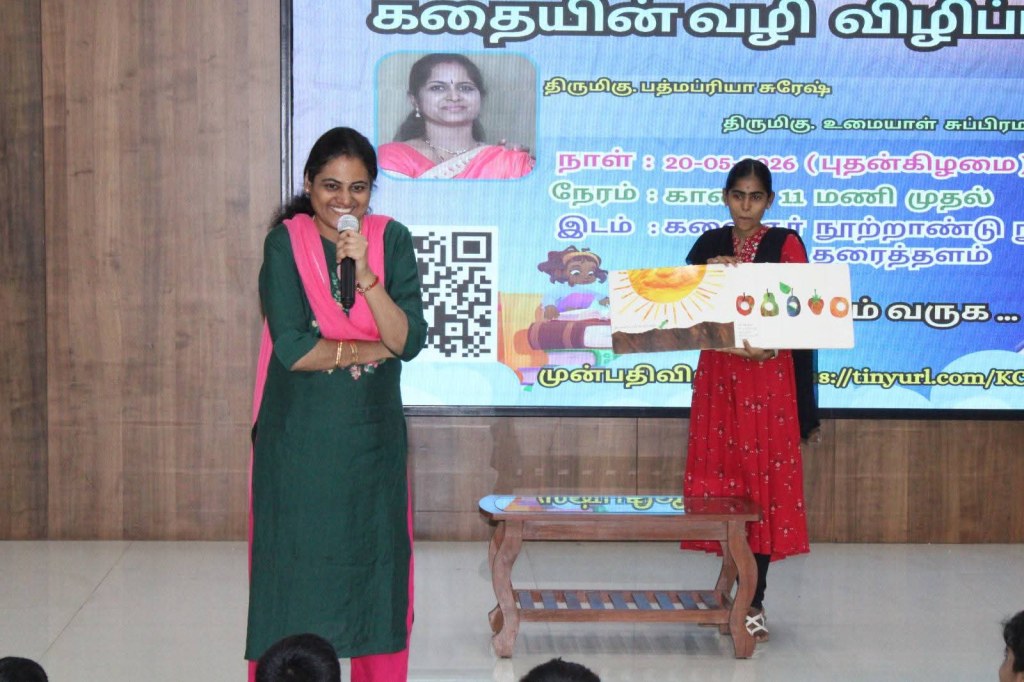
I started as an Early Childhood Educator. When I started, I did not have a background in Early Childhood Education. I had done a BCom with an MBA in Finance. When I moved from Madurai to Thanjavur, my aunt who ran a school in Salem, asked me to start a playschool in Thanjavur. She said there was no quality playschool. This was in 2009. I started the Squirrels playschool and every year 80-100 students study in the playschool. I love reading picture books and board books to the children. This is how my storytelling journey started.
Could you talk about your experience of reading and storytelling to children?
The more picture books i read I started getting different perspectives. Children don’t have any prejudices. They say what they think. It is raw and right out of their mouths.
Do you read Indian picture books or world picture books or a combination of both?
It is a combination of Indian and World Picture books. There are not many Indian board books. I like reading books which form a part of series – Elma, Maisy the mouse, Humphrey the elephant, Peter the rabbit etc. When it is a series, children relate to it much better.
I read Karadi Tales, Tulika Books, Pratham Books for Indian perspectives to be known to children.
Could you talk about your storytelling journey?
My storytelling outside the school started in 2022. I became a part of spectrum the awareness project in Feb 2022. That led me to do storytelling sessions. I did storytelling to create awareness around inclusion. I did storytelling in schools around Thanjavur. I did the facebook page of Spectrum – the awareness project. I am more of a writer than a storyteller. I like historical stories and stories revolving around Indic knowledge systems.
Could you talk about your interest in Indic Knowledge Systems?
Our traditional knowledge system is very old. Sangam Literature is 2000 years old. A sense of pride in our culture and tradition is what I want to evoke in the young children.
Have you read Tamil Sangam Literature in the original language?
I have read some Agamam and Puranam. Agamam are 400 songs that happen inisde the house. They are about the relationship between a man and a woman – Thaivar and Thalaivi. Puranam are about the King’s Dharma and songs on courage in the battlefield.
Could you talk about Tamil literature?
Thirukural is one book that has inspired me. There is a Thirukural – “The more you dig a sand-spring, more the flow. The more you learn more the wisdom.”
Could you talk about the Tamil Siddhar tradition?
There are 18 siddhars out of which Agastyar is considered to be the principle siddhar. There is so much STEM knowledge in the siddhar tradition.
Thirumoolar wrote Thirumanthiram. Bogarnather’s works include so much information on Chemistry, Physics and Biology. Siddhar medicine is popular in Tamil Nadu.
In Tamil Sangam Literature the landscapes are described in great detail could you talk about this?
The five landscapes are very important in Tamil Literature. Each landscape has a flower and God and profession.
These 5 landscapes are
Kurunji – Hill. The god is Lord Murugan. The profession is hunting.
Mullai – Forest. The god is Perumal. Lord Vishnu. The profession is shepherding.
Marutham – Fields. The god is Shiva. The profession is farming.
Neithal – Coastlands. The god is Varuna. The profession is fishing.
Palai – Desert, The goddess is Kotravai Durga. This is Kali worship only. The profession is robbery.
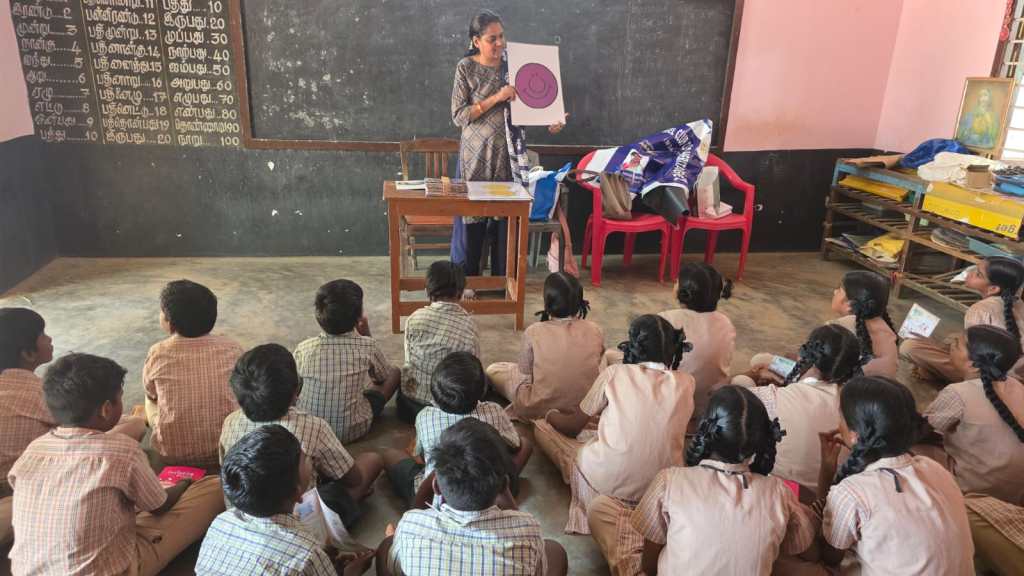
There are a lot of Indian picture storytelling formats. I did story cards In Warli, Madhubani and Gond. At the World Kamishibai Association I spoke about integrating Kamishibai with indigenous Indian art forms. Somewhere it feels like a full circle. Many people in India really like it. They use it as another added element in their storytelling. It has been a great journey of Kamishibai festivals, events and workshops hosted by the Indian Kamishibai Association.
We conducted an Integrated Gond art workshop with a reputed artist Mr. Raghavendra, we created Gond art for a traditional Japanese Folktale. We do Tezukuri Kamishibai sessions which is basically handmade Kamishibai. We pick one story, and storyboard specific to Kamishibai method of telling. We got an overwhelming response. It was magical. We got a lot of encouragement from Akiko from Japan. We thought why don’t we attempt something like this for the global audiences. IKA is planning to host a global Tezukuri festival. Our next plans are to use Kamishibai in education.
Last year, in October 2025 I went to Japan, to attend the international Kamishibai conference in Osaka. I shared Indian stories at the conference in the Japanese language. I took classes and I learnt the Japanese language. I will next be going to Japan in 2027 August.
I do a lot of sessions on storytelling, for storytellers, teachers and educators. I teach voice modulation and expressions.
I do a lot of puppet based storytelling. I have a whole collection of puppets. I focus on the story and how to make it come alive. I have performed at the Rangashankara main stage. I got opportunities multiple times to perform there.
Your favourite story?
Sharpen your saw – The story of the two woodcutters. They are caught in the rainy season. One wants to remain idle. While the other one wants to sharpen his axe. After the rains stop the woodcutter who sharped his axe was better equipped to deal with the wood. I believe this – continue to sharpen your saw. Don’t miss any opportunity to learn. I will be presenting a research paper soon at the SAC’26, International Conference Sustainability Across Cultures in Kerala, my paper title is Storytelling for Environmental Literacy: Adapting Chitrakathi and Kamishibai for Contemporary Ecological Awareness.
Could you talk about how you founded the Indian Kamishibai Association?
It was being a part of something magical. My love for Kamishibai started with engaging audiences largely children. There are multiple ways you are engaging them. The entire community of Kamishibai has been a support. Tara McGowan from the United States has been very supportive. To this day, a large part of my understanding of Kamishibai has been from Jackie Anne. They shifted my understanding of Kamishibai. I started the Indian Kamishibai Association on December 7th, 2021 on World Kamishibai day. Previously in India there were a handful of people who knew about Kamishibai like Geeta Ramanujam who has gone to Japan. In India, 2-3 people maximum had performed Kamishibai at the opening of the Indian Kamishibai Association. I started doing programs to bring the attention to Kamishibai. In the Indian Kamishibai Association there are around 115 members, storytellers, teachers, educators learning Kamishibai. A very senior storyteller in India asked me this, “You are doing a Japanese form what about the picture storytelling formats in India?” There are many Phad, Chitrakathi, Madhubani, Warli, etc.
The Chitrakathi has its origins in Pingula, Maharastra. Preserved through the Thakar Adivasi Kala Aangan museum run by the Gangavane family in Pinguli village, Maharashtra. They as community believe that their ancestors were spies for Chatrapati Shivaji. They used to go from village to village, telling stories with pictures, songs and music. Their actual work was however to be spies for the King. One family in Pingula has converted their cowshed into a museum. There is a fabulous book I am reading (PAINTING AND PERFORMANCE, Chinese picture recitations and its Indian genesis). There is this idea that picture storytelling could have travelled from India to China to Japan through the Buddhist scholars. Chitrakathi has been around since 1800s while Kamishibai started in Japan in 1920s.
I did my masters in psychology. I moved into industrial psychology. In DELPHI TCI, they were looking for HR executives, “We need HR executives who are Masters in Psychology rather than a HR MBA. I was the second rank holder. They reached out to my professor. I worked with a person who wants to be a soft skills facilitator. We worked on team building. Then, I moved to Sonata Software. I worked in training, with ten years of experience in HR. I had my son and opted of a full time option. I took a short break. In 2014, with a friend, we decided to start Katha Corner. This is a place where we would have storytelling sessions in the backyard for children. Both of us came from a theatre background. Year after year, we had the same children come in. I wanted to take my children own children with me to storytelling sessions.
I am self-taught. I attended a workshop with Eric Millar in Chennai. I trained with the Bangalore Storytelling Society. Then, I started performing in different schools. I performed for children. I am a freelance storyteller associated with Scholastic. I have experience as a performative storyteller. I have extensive experience to bring stories alive. I bring props. I engage children and we create a story together. The children become a part of the story. I alter the story to suit children’s reactions. One child will become the King and the others subjects in the same story. This way they own the story. In 2019, I started my first experiments with Kamishibai when I attended a workshop at a FEAST conference in Bangalore which was in association with Bangalore Storytelling Society. I did a workshop with two wonderful storytellers Jackie Kerin and Anna Manuel. I was there in the workshop and it felt like a light falling on a prism. There was so much to do with this form. Kamishibai started with the 1920s in Japan. Working on Kamishibai was to be part of something great.
Storytelling Accomplishments Performed at National Kamishibai Conference in OSAKA, JAPAN in October 2025
Performed at Vizag literature festival (Nov 2024), Mysore Literature Festival (Nov 2024), Kukdukoo Fest (Mumbai – Noida – Hyderabad – Pune – Gurgaon 2024-25) National Book Trust India (NBT ) – world book fairs (Pune – Delhi – Andaman and Nicobar Islands 2025)
Voice over artist for ZERODHA VARSITY JUNIOR – teaching financial concepts to children through stories
Performed at Little Cloud and AHA children’s fest – RANGASHANKARA, Bangalore
Teaching Faculty, associated with Acenovation for the Art of storytelling training at Muthurangam college, Vellore, a Nanmudalwan Initiative by TamilNadu Government (2023)
Featured storyteller at Auburn Winter Storytelling Festival, USA in 2022
Storyteller at Genre series at Storytelling Association of California (SAC) since 2020
Featured Workshop presenter at WKF World Kamishibai Foundation Write out loud USA, 2022
Storyteller at Bangalore Poetry Festival, and Bangalore Literature Festival 2023 (BLF)
Storyteller at the monthly series at Atta Galata Bangalore
Performer at BeST Festival (Bangalore Storytelling Festival) 2019
Curator and Storyteller at Under the Raintree Women’s Cultural Festival
Narrated stories at several festivals like Kereya Habba, Hasiru Dala – read-aloud story festival, KLAY – Lil Folk Festival, etc
Story sessions at over 30 schools across Bangalore and Mysore.
Corporate storytelling for HDFC and Adobe India
Won Best Actor in a state-level Drama festival
Facilitated workshops “Bridges that stories build”, KYOKAN – Learning the art of Kamishibai
Presented stories at Kukdukoo fest at Gurgaon, Faridabad, Noida, Jaipur, Hyderabad, Bangalore 2022-23
Storytelling Happy streets festival by Times of India group at Chennai, 2022-24
Performed for KALAATMA – Power of art- a devised theatre production, 2022
Facilitated “Art of Storytelling” Workshop for teachers at EDIFY school and Vydehi School of Excellence – 2023, NPS, Edify
Facilitated “Niseema- Beyond Boundaries” a performative Story presentation on DEI – Diversity, Equity, Inclusion for corporates like Interweave and Tesco Bangalore, Mercedes Benz
Storytelling for children at Happiest Minds Bangalore
Facilitated Storytelling sessions in over 50 schools in Bangalore and Mysore, including prestigious institutions like The International School Bangalore (TISB), Vydehi Institutions, NPS, DPS, Aditi International school, National Hill View Public School, Oakride Internation school, Canadian International school, Excel Public School Mysore etc,
Could you talk about your writing career journey and what led you to write ‘The Black Flames Trilogy’?
In 2020, it was an uncertain and decisive year for everyone. Everyone took the plunge. Everyone wanted to know ‘what I can do?’
Writing came naturally to me. I started writing, the response for good. In 2020, I started writing short stories. I wrote a couple of stories. In April 20221, I started writing poetry. In January 2023, the goal was to write 3000-word short stories. A friend then urged me to write 5000 words and she gave the topic as noise. I wrote 75000 words, this was surprising for me. I never knew that I had a single book in me. I knew I had all the text for the next two books too.
Could you talk about the genre of your book?
It is a mystery thriller. The plane falls from the sky. I wanted it to be a little unnatural and unique that why I created the flames as black. I did research this and found that flames can be other colours also. Black Flames are possible.
Could you talk about your favorite books?
I am an avid reader. I am very fond of Kavita Kané. I like Kate Quinn – The Alice Network. I love her voice. I love the way she writes. Initially I used to read more mystery thrillers then I also started reading romance.
Could you talk about your own self development process as you wrote this trilogy?
It has been very profound. It has been three years that I have been writing books now. I am able to embrace my own emotions. I gave the first draft I wrote to my friends. They said readers connect to the emotions of the characters in the book. Writing this with the emotional arc gave me better grasp over my own emotions.
I do believe there is a writer in each one of us. Writing these books definitely changed me.
Could you talk about point of view?
I did not know there was something called point of view when I started writing. It just happened. I wrote in the third person point of view. Something was happening in my head, I was recording the story as it was forming. In the first book itself I get into multiple point of view. The characters had their own arcs and their own journeys – they deserved their own point of view. I have given them their space.
Could you talk about your key writing influences?
There was no specific writer who influenced the book as I was penning it down. The story was flowing through. I was reading Julia Quinn and that influenced the romantic angle a bit. I was finding my own voice. I do love many authors, but I cannot say any author inspired me to write this book. The story is about a miracle cure. The whole story is that a miracle cure exists.
You follow the Nam Myoho Renge Kyo practice. Could you talk about the influences of Buddhist psychology in your book?
In Buddhism it is said, “when a great evil occurs, a greater good follows.” In the story of the Samudra Manthan, Amrit (the nectar of immortality) comes out and so does Vish (poison). It also boiled down to changes and transformation. The book is about Kiara’s transformation. In the book Kiara starts as a scared damsel in distress but she changes.
My Buddhist philosophy pulled out the writer in me. I could not have been a writer at all if it was not for the practice.
I feel we as humans are not black or white. We are all grey.
There is a concept in Buddhism called Fundamental Darkness. Each of us has a Buddha in us and also the Fundamental Darkness. For most of the book Nichiren Buddhism helped me recreate the Fundamental Darkness. From Fundamental Darkness, we have to move to Buddhahood. That is our highest potential.
It is a pure mystery thriller with angles of romance. Buddhism gives you more perspective. You are able to focus on and pull up your life state. From Fundamental Darkness we have to go into Buddhism. We don’t know how much potential exists within us.
Could you talk about Indian writers getting international recognition?
Banu Mushtaq won the International Booker Prize. It was a proud moment.
Speaking of Banu Mushtaq whose writing has words from Hindi, Urdu etc, could you talk about the language base of Indians?
Indians are linguists. We speak at least two languages. That gives us an edge. It refines you. I speak Hindi, English, French and Japanese. I write only in English. I have written a few French articles for my blog. I relate to English the most and Hindi is my mother tongue.
Could you speak about how you plotted and structured your books?
When I started, I did not have any plot in mind. It was pure instinct. I never had it in mind to be a writer. I sought solace in writing. Poetry also happened as therapy. I learnt how to swim by diving into the water.
Could you talk about chanting the Lalitha Sahasranamam in a rare raaga?
During my childhood days, I started learning music from a Kanadiga teacher Mrs Subbaramu. I went to Geetam and Varnam level, but then there was the pressure of studies. The teacher was a Sai Bhakt and soon we started learning Lalitha Sahasranamam from her. She used to teach us for free. Not a penny she had taken from us, not for teaching music, not for teaching Lalitha Sahasranamam.
We did not know then the raaga was a rare one. The raaga was in Raagamalika based on different ragams.
The rare raaga in which you are singing the Lalitha Sahasranama sounds like a Carnatic music version of the chant with longer aas, ees and longer vowels in general?
Our teacher who taught us the Lalitha Saharanamam was also a Carnatic Music teacher but she said she had learnt it from her teacher who was from learnt it from her teacher who was from Neyveli. At that time, we did not know what other versions of the Lalitha Saharanamam were available.
Could you talk about the importance of mantras such as the LalithaSahasranamam?
Personally, I have experienced this – whether you are unwell physically or we feel low, chanting such raagas or chanting such shlokas really helps. The whole thousand names of Lalitha (in the Sahasranama) that I have learnt are in a very rare raaga, not available on YouTube.
I was born and brought up in the Central part of India, in Madhya Pradesh. We are actually from Kerala. We wanted to be connected to our roots like the rest of the family in Kerala so we would listen to Suprabhatams, Iyyapan Songs, Iyyapan Bhajans etc. We were living in the North and did not want to let go of our roots. That made us want to follow the tradition. Our culture is based on shlokas, rangolis etc.
Could you talk about the importance of the Sanskrit language?
Sanskrit is the mother of all languages, the Hindi we speak, Tamil, Malayalam etc. It is regarded by all as the mother language. Every word is spoken clearly. In Sanskrit, the importance lies in pronunciation. The pronunciation is Sanskrit is very precise.
I can relate to the Sanskrit sounds as a Temple bells which are divine sounds. You feel the divine is in you.
Could you talk about the Aham Bhramasmi of Vedanta?
Aham Bhramasmi means the divinity is within. Everyone is connected to the supreme being. The divinity is within everyone.
Could you talk about the Indian tradition of worshipping the Mother Goddess?
Indian tradition always celebrates the female – Lalitha, Durga and Kali. The central part of the Indian tradition has been Devi. And Devi is celebrated in many forms. Durga, Kali, Lalitha, all triumph over demons. The triumph is of righteousness over wrong doings. I have always worshipped Devi.
As a gynaecologist, could you talk about sound and healing?
Listening to or chanting of shlokas are specially good for the expectant mothers.
But, for sound and healing, the chant need not be only in Sanskrit. It is not necessary that you should be able to chant a shloka. Even singing and hearing light music sounds helps in healing.
Could you talk about the centrality of Sattva in the Indian culture?
Sattva along with Tamas and Rajas is a part of the elements of Prakriti. The goal is to move towards Sattva.
Any parting thoughts?
The more we move closer to nature, the easier our lives will be.