Your career journey?
I started as an MBA aspirant and did an MBA with Marketing as the main subject and Finance as the minor subject. I was in the banking sector. I was doing well. However, it was not what I wanted to do. Banking was not filling my cup. We shifted from Mumbai to Ahmedabad. I was not travelling so much with the kid. I started Thinking Hearts. We would not contract with anyone. Ours is a nomadic brand. We would take our bag of stories with us and share the stories, one story at a time. I have seen the magic unfolded at that time. Someone in the audience is seeing opportunities and possibilities through the story. The audience can explore the world through stories – Korea, Japan etc,. If there is a white tiger in the story, they try to understand the white tiger. They try to see the real story. What is the real story in “Three for free” a Taiwanese tale about how a mountain was eaten. The story is about how the top half of the mountain was eaten by a group of greedy villagers when the mountain was offered as food by the Mountain deity. Such stories have different meaning for different people. The basic theme in this story is that there is nothing free in this world.
Could you talk about your organisation Thinking Hearts?
Thinking Hearts is inspired by my child’s uninhibited ability to express and identify what he would in the world. Recently I attended a theatre workshop by Micheal Chekov. During this workshop he talks about a quote, “Artists think with their hearts and feel with their minds.” From around the 1935 to 1945 a practitioner thought of the Thinking Hearts Philosophy. I had joined this workshop for learning movement, expressions etc, and found out about this older philosophy also called Thinking Hearts.
I just gave Thinking Hearts all I have. We don’t sign any contracts. We have done free workshops in Ahmedabad – NGO schools and kids events.
When I do a storytelling session the kid’s eyes just light up. They are following you like a CCTV camera. They just feel and take it all in. The moment that is most important, the aha moment – i do my best for that.
Could you talk about your storytelling mentors?
My mentors have been Geeta Ramanujam, Roger, Shiela Wee, Kiran Shah and Jeeva Raghunath.
I met Geeta Ramanujam two years in the Himalayas where she was doing a Storytelling Certification Course. I had heard a lot about her. In the first class she made a deep impression. She would mould herself to do something transformational. She has become an expert at this.
I met Roger when he visited Ahmedabad for 5 days – sharing stories and sharing how to deliver the stories to adults. It was a lot of soul food. I learnt how to connect with audiences.
Geeta Maam taught about different types of listening. She taught us about how audiences feel when they listen to a story. The heart becomes a part of the core.
I met Shiela Wee and Kiran Shah as a part of FEAST. They spoke about how to capture your story, expressions while telling a story, how you the storyteller can feel what the audience feels when they feel a story.
I am doing a mentorship with Jeeva Raghunath maam on storytelling for adults.
Could you talk about you being a mentor to your storytelling audience?
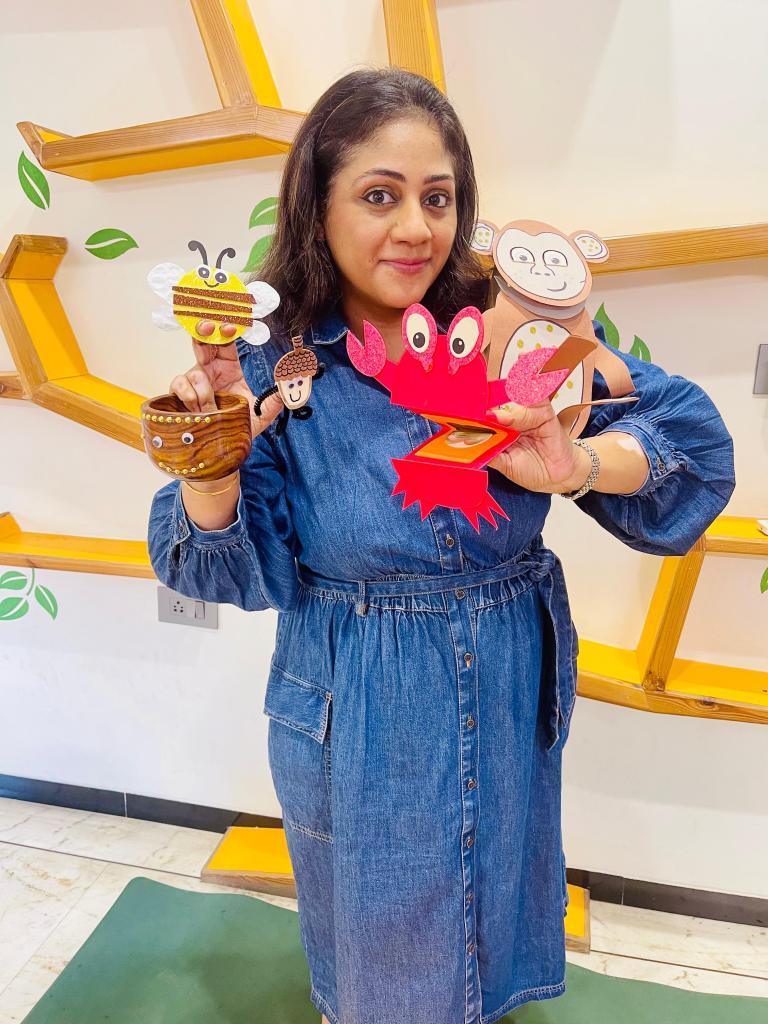
Every child comes from a different ecosystem. They all embrace different value systems, different ways of thinking. I can’t judge, I can’t mould. It is my duty to listen well. I listen to how their voice and language is changing after the story. The children do creative journalling. They do work around the story – Where the story came from? What book the story was originally from? If they can make a puppet or some prop with which they can share the story when they get home. How they see the story differently? We work together on story structure modules.
A child who has been silent through 8 sessions speaks up in the 9th session. The story in hand is of a mermaid being captured by a boat. So, the child speaks up and says put a tracking device on the mermaid. He was 5 years old and was not even able to say the words clearly. I asked him several times. Then we sat with him for three sessions to understand his perspectives on the stories and he had some much to share. My work is done.
Could you talk about your storytelling style?
My style is more participative. That’s why I attend theatre workshops too. I have learnt that even a little gesture matters. I usually end the sessions with hands on activities. In the story of the three dolls, I teach children about friendship. The Prince doesn’t know how to choose his friends. All children ask – Is she my friend? Is he my friend? Sometimes children feel left out in a group. The question was how to present such a story in front of children, I made mud dolls with the Kumhar, potter. I sat with him and made three distinct dolls with straw placed in the ear and the other end in a different location for each of the three dolls. The child can visualize which type of friend she or he wants –
One who hides all secrets
Or One who does not share knowledge with you
Or One who hears gossip about you and tells you instead of participating in this gossip
Where the straw is placed on the dolls helps the child visualize these scenarios. The question that is asked of the audience is – which doll do you want to be?
There is this story of a single grain of rice. A girl wins a bet with a Raja for getting a single grain of rice in front of five of the villagers. It is interesting how the story unfurls. The Raja agrees to double the rice, everyday for the next 30 days. On the 30th day, 56 elephants carry the rice into 4 storerooms. I had made 56 cut outs of elephants for this. By doubling the quantity of rice Brahma Bulls etc, are needed to carry the sacks of rice.
So the story goes –
32 Brahma Bulls carrying the rice.
56 elephants carrying the rice
Even a little child has some takeaway.
Could you talk about the distinguishing features of Indian stories, as compared to world folktales?
In Indian stories you find everyday life blending with the divine. There is a lot of complexity in Indian stories, moral complexity – ‘what is the truth?’ There is a lot of diversity – stories from Gujrat, Nagaland, Kerela – with different languages, different values. Food stories, different types of stories. There are a lot of sources for stories the Panchatantra, the Katha Sarit Sagara.
Could you talk about your personal favourite story?
I like the trickster spider tales – the Anasi stories. My personal favourite story is a Bantu story, “The story of the tree.” In this story, the animals get together when there is a famine and the winner is the underdog. The story speaks in 100 voices. There is wisdom and wonder.


