Could you talk about the story summary?
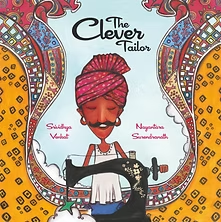
This is the story of the tailor Roopa Ram. It shows how creativity and care can transform scarcity into abundance. I see this as a powerful story on sustainability, resourcefulness and emotional values of simple things. He doesn’t have much, he is not a wealthy tailor. What is unique in the story is that Roopa Ram has the ability to make himself happy with what he has. When he gets the pagadi, it is to him more than a simple piece of cloth. Then this cloth changes from one form to the other. This remains a symbol of usefulness and continuity. Objects can have many lives when treated with care and concern – not only for children but also for adults.
What are your reflections on the story?
We are living in a world where we keep acquiring things and discarding them. In older times, people would repair things, reuse things and value their belongings. The story speaks against wastefulness and talks about sustainability.
Everything Roopa Ram creates is for someone else in his family. The story revolves around affection and thoughtfulness. Love can be experienced in each act of care rather than expensive gifts.
You should not count if you have this and that. You should use whatever you have with you with your own imagination is what this story teaches us.
Could you talk about converting an original English story into Hindi storytelling?
I made the story my own. It is set in Rajasthan and I tell the story in my mother tongue, which was all the more easy for me. The audience were government school children. I have made my own translation of the story.
Can you talk about compassion in your storytelling?
Whenever I tell, I tell with all my heart. If I am not able to connect with the story I don’t tell. When I tell a story with love and emotions, it comes out so easily.
You have to believe in the story, and you have to believe in yourself. Otherwise you will not be able to connect with the audience.
I have told stories on the autistic group Spectrum. Both were in Hindi. One has been a story within a story. The other story was about the acceptance of autistic children by people. In this story, an autistic boy is stopped from playing. The others feel he does not fit there. Then the boy is given colors and paints and everyone can see how brilliant his art is. The story ends with people realising that because he is different he cannot be excluded from playing. I had sent my script to my organiser. I told her, ‘you refine the language’. I wrote autistic child, she wrote neurodivergent.
If you are telling an audience, you have to be able to connect with them. When I am not ready, I don’t tell stories. When it doesn’t come from the heart – I don’t tell stories. In Rivers of India by Spectrum – the awareness project, I tell stories of sisters who become a lake in Meghalaya.
Why is it important to be able to know and connect with your audience?
If a storyteller does not believe in a set of audience, say is not comfortable with children aged 4-6 and will get irritated if they run around, they should not do the session. You should be connected with your audience.
My experience with children is that when I am able to tell stories, they become attentive. They usually come up with what they understood or what they take away with the story. Generally they use gestures to show you they care – it can be a smile, a nod of the head, any favourable movement. These tell me that we are on the same page. That is how I feel and connect with the audience.
You do have nonverbal communication also. A small tear, here and there, if there is an emotional connect. Sometimes, when the session gets over, I let them talk. People don’t need advise. They need an ear to listen to things bottled within them.
I bought Kahani Thela to Jaipur through the Delhi Storytellers Tribe for the first time. I went to an NGO that is for girls under 16 whose parents have died of AIDS.
I could feel my heart. I was wondering if I would be able to or not tell a story for them. They were struck with wonder – ‘who has come to tell us a story?’
For me it was a learning. For them it made a world of difference. Next year, I went to the same place. Most of them remembered me.
Could you talk about body language and other storytelling techniques?
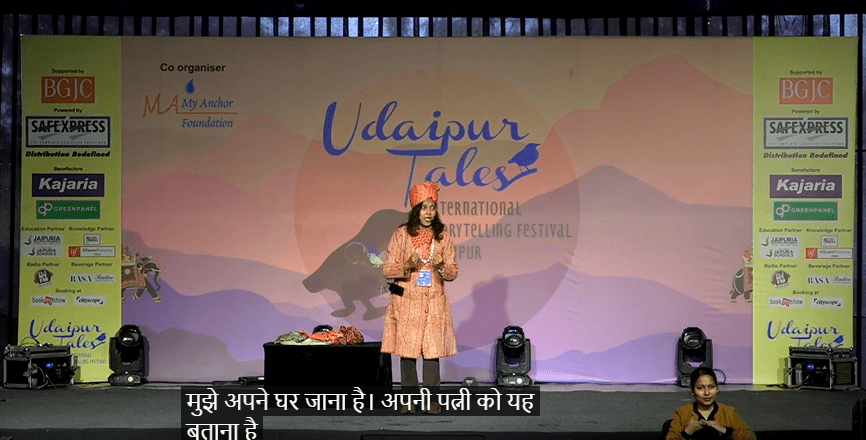
When I was performing in stage, there is a wide scope of storytelling techniques with props, body language, gesture and movement. The body language I used for Roopa Ram, the tailor included how Roopa Ram was standing, how he was carefully working on the oodani for his wife. His open energetic posture. When the tailor goes home – gentle and loving body language. My movement was heavy to create dynamic walk movements, carrying things very proudly. I had used repetitive stage actions. Gestures was another element. I used my hands for every gesture. I showed with my arms ‘It became smaller and smaller’ – all the gestures made the audience visualise the story.
Through facial expressions, we can add emotional expressions.
I used singing, “Mera Naam Roopa Ram..” Everyone showed surprise and delight when I sang that song. I used voice modulation e.g. softening the voice to show family love. All this made the story very visually powerful. It helped the audience see the story very clearly.
Could you talk about connecting to audience with familiar language?
I frequently connect to the audience with dialogues they know. Like the Mahabharata dialogue ‘Main Samay Hoon’ I changed it in a story to say ‘Main samaya hoon. Main Konark temple hoon.”
I frequently use the la la la la from kuch kuch hoota hai. I have been often complemented for doing humorous work e.g. in the Gatha Festival.
Story Reference for further reading
YouTube> Shilpa Mehta | Performance 2025| 6th edition
The book