Could you talk about your storytelling journey?
All of us are natural storytellers. I started my journey as a professional storyteller in 2018. I had been on a solo trip to Coorg. The plan was to trek up the highest peak, Tadiandemol. Unfortunately, I had to shelve the trek as there was a ban on all trekking in South India. Fortunately, I met an excellent Storyteller, Subba Rao who I learnt had partnered with Anant Pai in bringing stories from Indian mythology to the public in an easy to read, comic format, the very popular – Amar Chitra Katha. I used to love these comics as a child and collected quite a few of them. I was indeed very lucky to meet him so unexpectedly.
Subba Rao was on a holiday with his family, his wife, daughter-in-law and her father. One morning when I was setting out for a walk, Subba Rao introduced himself to me and asked me if his young daughter in law, Ankita could accompany me. I agreed and we went on a long walk and got to know and like each other. After we got back Subba Rao and started chatting. In the course of our conversation, I came to know about his Amar Chitra Katha journey. He then told me two simple stories, told without any dramatic actions but they had the power to keep me riveted.
I was so impressed with the stories he shared and the impact they had on me, that when I came to Chennai, I decided to start my journey as a storyteller by launching KathaVriksh. This was so that I could start telling stories and spread the joy of listening to stories. I began my journey with an open mic for adults to share personal stories. I felt that this would create a safe space for strangers to meet and share their stories. Invariably when we share stories we get to know and understand that our experiences are very similar. In the few months, after I started the event, it was starting to pick up when covid happened and I had to cancel the event scheduled for March 2020.
Everything went online and I too joined the online community. Covid was actually a blessing in disguise because it opened up doors to the wider world. I discovered a community of global storytellers. I started attending story swaps curated by storytellers in the US. I got to listen to some amazing storytellers and the best part was that I could share stories too. This widened my repertoire of stories and I learnt a lot just by watching others tell stories. All kinds of stories were shared, personal, fairy tales, folktales, myths, legends, spooky ones, practically every genre in the world. I made so many friends and I am still attending these swaps as a couple of them have continued online.
In India, I collaborated with four storytellers from other cities and each of us shared folktales from the four southern states of India. The event was ticketed and there was a very good response. I continued to collaborate with other storytellers and the events did really well in terms of audience.
In November 2020, I decided to launch Katha Potpourri. It was an online storytelling festival that happened over three days, Friday, Saturday and Sunday. On each day the session lasted for an hour with four storytellers sharing space. I invited experienced storytellers from India and abroad to share stories. The event was ticketed and going by the response, I made this a recurring event, every two months. This went on till mid 2021, but by then people had started offline sessions and so I discontinued the event.
In 2022, I started sessions for children at different locations and managed to attract a fair number of participants. I enjoy telling stories to children and I always ensure to add some songs and music so they can sing along. The parents also enjoy when the sessions are very interactive.
On your writing and storytelling?
I have written a lot of stories. I share these online. Appa’s Sambhar was shared online. People liked it and asked me to publish it. I self-published it.
In order to keep learning, I still continue attending story swaps every month. I attend three in Australia, three in the US and two in the UK.
I participate in storytelling festivals in India and abroad. I attended the FEAST conference in South Korea in September 2024, Sydney International Stortellers Conference in Sydney, the online Chennai Storytelling Festival which happens in February every.
Only storytellers have the power to change society. I do my best; I coach people in storytelling. I have trained professors and teachers in using storytelling in the classroom. Storytelling is all about changing perspectives. I am also a voracious reader. As an adult, I still read picture books; there is so much wisdom in them.
Could you talk about Appa’s Sambhar?
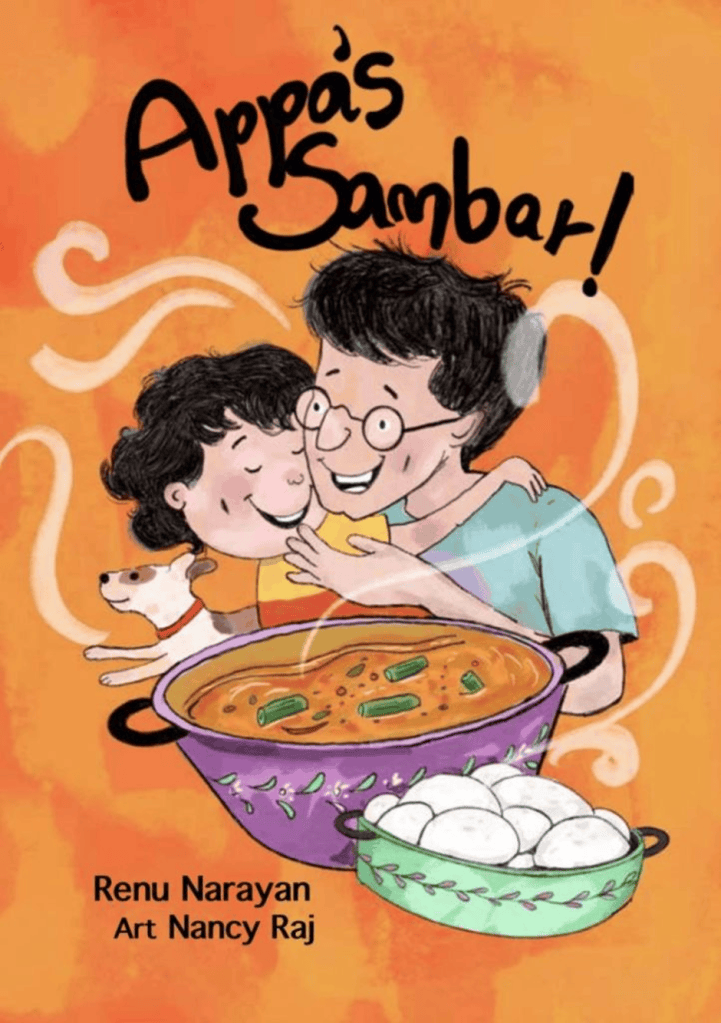
The book was envisioned with the idea of breaking stereotypes No household chore is gender specific. This needs to be introduced to children while they still very young. There is no mother in the picture. The father is cooking for the child. And what he is cooking is idli and sambhar for breakfast. The story is about the bonding between the parent and child. The father finds that there are no vegetables in the fridge. He looks out into the garden and realises that, “our garden has vegetables that we can use.” He goes into the garden and he and his son pluck the drumsticks from the tree. The story introduces the different dals and the one that is used in the sambar. At the end of the story there is an activity that can be done at home or at school along with the child.
The book has done well. I had 150 copies printed and all of them got sold.
Could you talk about your storytelling styles and techniques?
I got introduced to Kamishibai in 2018 when I attended a workshop presented by Jackie Kerrin who’s from Australia. I fell in love with the art form. It’s an ancient Japanese form of storytelling. Kamishibai storytelling is done through a Butai or a wooden story box. I couldn’t source one anywhere so finally I commissioned a carpenter to custom make it for me by showing him some videos on YouTube. I also needed the picture cards for the story. I had to find a source for these cards. After asking many people, I finally found an illustrator and storyteller based in the US. Yumi Izuyama is a Japanese American storyteller who lives in Boston. She very generously shared many illustrated stories with me for a very nominal cost.
In December 2025, I went to Mysuru and learnt puppetry from a professional puppeteer . He taught us to make our own puppets and how to use them effectively. Mr.Sashidhara Adapa is an accomplished and famous puppeteer, who designs puppets for the government of Mysuru. His puppets are used in the float representing Karnataka at the Republic Day parade. He taught us how to make papier mache puppets. Children enjoy stories that I tell with puppets. I use a lot of music, singing and musical instruments during the story sessions.
I also perform Shadow Puppetry. My daughter is an artist and makes the shadow puppets for me.
Could you talk about your favourite story?
This is a story I heard from Jan Blake, an African British storyteller. It is called the Camel Driver. It’s a wonderful story and I have told it many times. The story is about human connections. The story reflects the importance of integrity and justice. You can find this story on YouTube.


