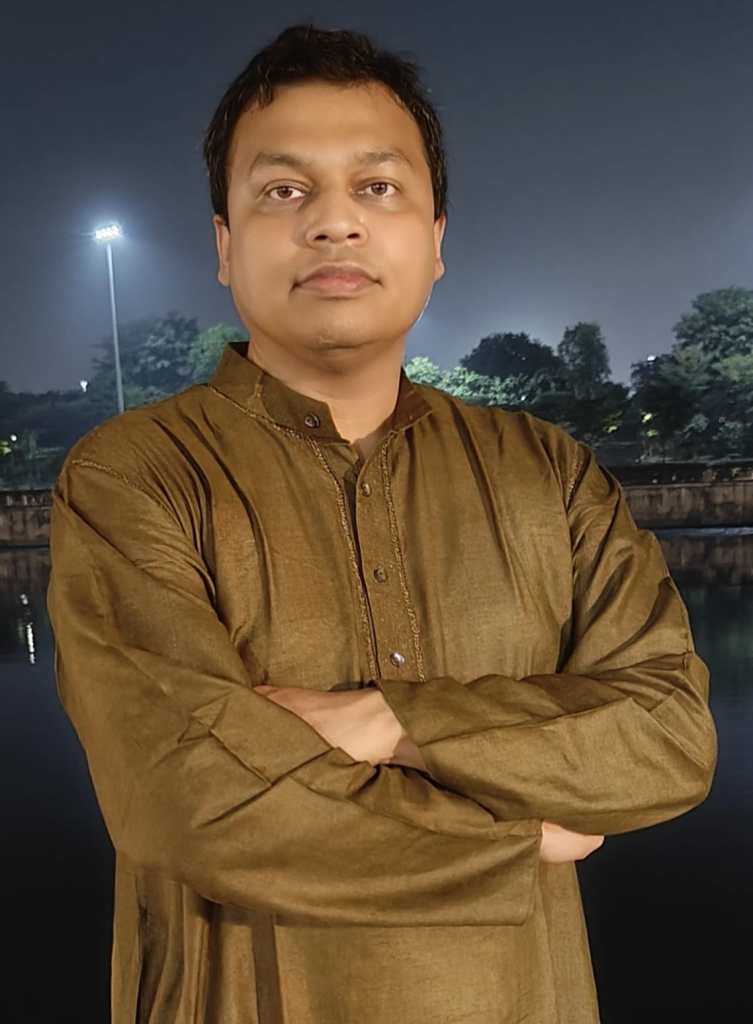
The background to your book Vritrahan?
This project was super under scrutiny, with people saying you are doing another rewrite, another myth retelling. There is a whole genre of myth rewrites. People couldn’t understand what that book could be. It was not something to gratify my own hubris. In youtube, you find a host of Kathas. In the length and breath of India, there are katha performances. These are a particular form of cultural continuity. These stories in this form are something that don’t exist in English. I tried to write in that manner, the manner of the Katha performances. The writing feels like a storyteller talking to a physical audience. To replicate the Katha tradition in English was my goal. I wanted to render a Katha telling of Indra in English.
Could you talk about the poetic form of the book?
When I first started writing I had a bigger agenda. I wanted to make my own meter to compose the poetry in, a meter like the vedic meters like gayatri. I was writing into excel to map the meter for the first few chapters. Then I felt it felt less like the book and more about satisfying my own ego. I changed to free verse. Some shape of the earlier writing is still visible in the book. The work will not be good enough if I satisfied my ego and wrote in this meter. So, the transition to free verse happened.
Could you talk about the story of Indra slaying Vritra, the core of the book?
The story of Vritrahan is found in the Vedas, Itihasas, Puranas, and the Tantras. Every spiritual path in the Sanathan Dharma has its own reference to this particular story. While the Veda is the primary source, it is the only universal tale of Hindu spirituality. The story of Vritra is under expressed in modern literature. I could find three different versions of the tale in the Mahabharata. Each of these versions had very different details. To write a version which was acceptable to people following different paths was a challenge. It was less of a cultural challenge more of a spiritual challenge.
Could you talk about the Yagna and its central place in your book?
One of the things that I find problematic is that there is a sense of entitlement “we are supposed to get it.” Yagna is fundamental to how nature operates.
- You are donate something dear to you
- You evoke a higher power
- You do it for lok kalyan
- You get the fruits
This concept is under severe threat due to AI. You have bypassed the initial stages, and because of this you can’t understand the worth of things. The worth of the outcome grows less and less. This reflection in the quality of spiritual worth and mental ability to understand something can’t be born out of nothing. You get an outcome after offering something that is important. And so, we are losing a big sense of that with AI. Getting something so easily just devalues the thing over time.
Your book is a deep reflection of Indic philosophy and is expansive in its coverage of Indic Theory. Could you talk about this?
We have too much politics today. What happens is a power given to tribalism – this is ours, this is yours and this is why we are different. Then there is a deep ontological differences from the Abrahamic sects. Unless we are aware of our ontological differences – we will feel this is culture, these are the temples, these are the deities – you don’t know the true truthclaim of our culture. Unless you know what we stand for at a fundamental level. If you look at the Levels of Culture –
- Outward manifestation like Namaste
- What are your values?
- What is your truth claim?
Unless we know the truthclaim we cannot know. It is important to know the truthclaim of who we are.
Vritrahan is a vedic story. It is essential for us to understand the context and the underlying philosophy. Without that philosophy this can sound like a very mean and very petty tale. It is not a petty tale between two tribes. It is a tale that spans cosmic dimensions – at a time dilation level, cosmic level and spiritual level. The time is that happened in the past, will happen in the future and is happening now.
 Story Practices
Leave a comment