Author: Story Practices

  • The growth of storytelling in India – Interview with Deivanayaki

    Kathalaya Impact Series

    How did you first associate with Kathalaya?

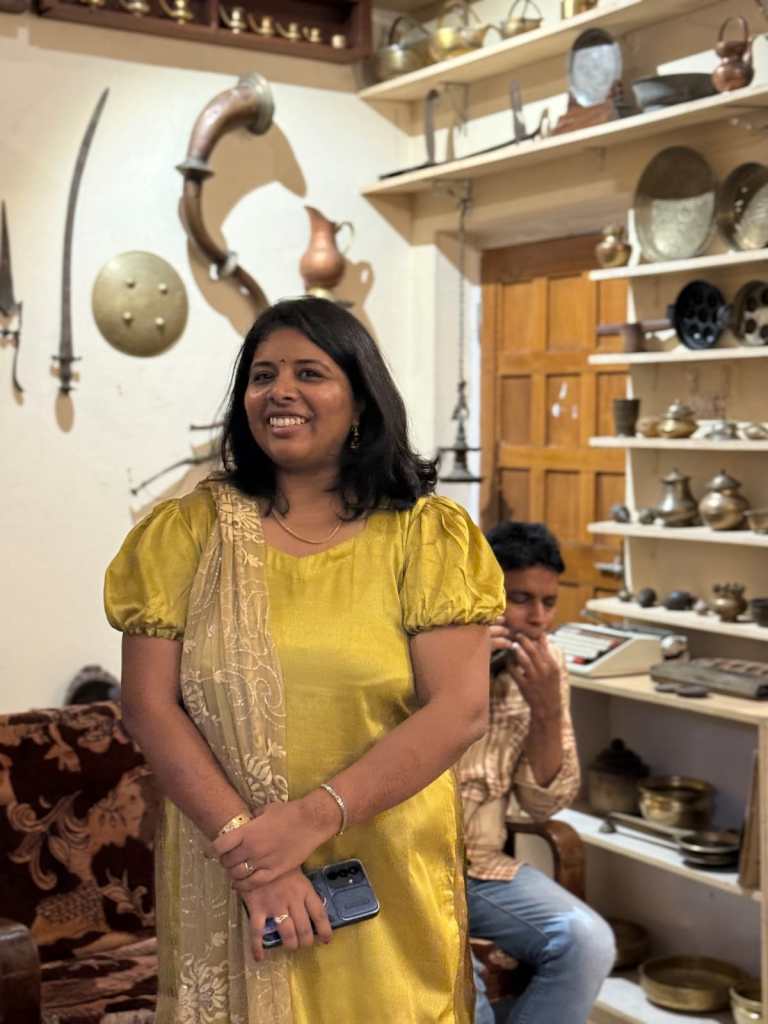
    In 2011, my cousin saw an Kathalaya advertisement in the Hindu newspaper. We wanted to enquire about and do the course. She was in Madurai and I was in Bangalore. I just dropped into the office and enquired about the team. It was nice meeting Geeta Maam. I did the first level beginners’ course with my cousin in 2011 January. It was a five day half day course.

    I became a storyteller and started telling stories at a local school.

    In 2011, my cousin came across a Kathalaya advertisement in The Hindu newspaper. We were both interested in learning more about their courses—she was in Madurai and I was in Bangalore. I decided to drop by the office to enquire, and that’s when I first met Geeta Ma’am. My cousin and I enrolled in the beginners’ course in January 2011. It was a five-day, half-day program.

    After completing the course, I began storytelling at a local school. Although I enjoyed it and worked until 3 p.m. each day, I still had some inhibitions.

    One day, Geeta Ma’am asked if I would be interested in working at Kathalaya. I thought it would be a good opportunity and decided to join initially for three days a week. Since 2012, I have been a permanent employee at Kathalaya, handling administration. Over the years, I have listened to countless stories—shared by students during their courses and narrated by Geeta Ma’am herself. Being fully involved in administration has helped me shape my career at Kathalaya.

    My journey with Kathalaya began in 2011, and it continues to be a meaningful part of my life.

    You started your association with Kathalaya in 2011. Since then, what are the changes you have seen in the field of storytelling?

    In every field these days, you can see a huge change. In the initial years, Kathalaya was the main centre for storytelling and then there were not many people who could tell stories. Now every place be it Indranagar or Koramangala is developed in storytelling. There are many storytellers and storytelling centers are being opened regularly.

    People used to come to Kathalaya to learn storytelling. But we also saw that online storytelling became very popular. Online storytelling and podcasts became very popular. There was a huge change in this sense is what we felt. Except during Covid, Kathalaya did not prefer the online model for teaching storytelling. Storytelling is an art that requires personal connection. While people ask for online classes, we ask them to come for our in-person workshops. We can see how storytelling careers revolve around what we experience with people. Hence offline storytelling classes are better.

    Another change we have seen is that earlier teachers, homemakers would attend storytelling classes. Now people in all fields, entrepreneurs, media people, corporate employees – people from different background learn storytelling to apply in their fields.

    How has working with Kathalaya, which founded storytelling in India and many parts of the world, developed you personally?

    It’s not just a course. Each one would come with their own feelings, their own anecdotes, their own wisdom, their own stories. You need someone to listen to your stories. People like being listened to. Their stories being heard. They need a person to hear the stories. Storytelling plays a very important role in sharing what happened yesterday.

    Could you talk about the key achievements of Kathalaya?

    Kathalaya which was founded by Geeta Ma’am, has spread the art of storytelling nationally and globally. Storytelling has spread everywhere. We have been conducting storytelling festivals all over India and the world. We have been in the Limca book of records. We have taught storytelling India and abroad. We have impacted more than 5,00,000 children. Many children who grew up listening to Geeta’s stories have now grown up and affectionately call her Story Ma’am.

  • The story of Ganga – A storytelling video by Deepa Kiran

    A myth or a sacred story holds much significance for a people and their culture. It is the lived belief system, a way of veneration. When a performing artist and international storyteller as proficient as Deepa Kiran performs the Ganges story – all one can do is stand up in applause. This story is performed on a boat in the Ganges in Varanasi. The boat sways gently in the river and Deepa Kiran seated in it tells us and the river the story of Ganga Devi. The power of Indic storytelling lies in the fact that the more we repeat our stories and the more we transmit them in a tradition approved method, the deeper we sink into yoga and a yogic experience of our culture. In Indian storytelling traditions it, the act of storytelling can be therapeutic for the audience where they attain salvation or Mukti through bhakti. Storytelling is one of the traditional forms of Bhakti yoga. This narration helps us the audience experience a Ganges like purification process, an attainment towards nirvana.

    The story of Ganges as performed by Deepa Kiran offers a lens into the traditional Indian stories and storytelling. These traditional stories transport us back into the world of gods, rivers as goddesses and monumental crisis resolution through the tapas of yoga and determination. Told to the tune of the Shank, the sounds of the Ganges, Sanskrit Chants and traditional musical instruments, this is one compelling performance – Story of River Ganga

  • Dr. Abdul Mohammed Ali Jinnah brings awareness about Endangered Animals through series of stories – Part 2

    Could you talk about postmodernism and the theory behind your book?

    The books are not very postmodern to start with. But they do become more and more postmodern as we progress. In college, I teach postmodernism. But I don’t just teach postmodernism I live postmodernism, I follow postmodernism. I am situated within the postmodern praxis. It is a part of my life.

    There was a deep urge to talk about ecology. There was not much that they were real books, they were stepping stones. There was this innate urge – I needed to explain how the ghariyal remained in my memory. I wanted to talk about the ghariyal and how it was going extinct. The idea was to communicate all this to children between 5-10.

    One can examine these books in the context of eco theory.

    Could you talk about children’s books in the ecology space?

    When it comes to children’s books in the ecology space. I had read Kaziranga Trail by Shankar. This was Shankar from Children’s Book Trust. I read this in the fifth standard. It initiated me into the Indian Rhinosaurous which was being hunted for its horn. His book featured a Rhino which was being poached. That’s how I as a child got to understand how Rhinos are being hunted for their horns. I understood how animals are being cruelly killed for the material profits. I read the book 100 times, it was my go to book. It was a phenomenal book. I also read Swami and friends at that time which was written for adults but about children.

    Then also read Tinkle, Amar Chitra Katha, I had met Uncle Pai also. It helped me balance away my identity as an Indian. Then there was Enid Blyton, Hardy Boys etc. I think detective fiction is needed for young adults. If we had equivalents of Three Investigators and Hardy Boys. There are a few Indian detective stories for children. There could be more focus on this area for rural and semi urban adventure.

    Could you talk about the importance of reading encyclopaedias on ecology?

    When I was young, one of my father’s friends Mr. Ramachandran, was collecting encyclopaedias for his unborn children. I got to read these books through his lending them to me. There were a lot of How and Why and other encyclopaedias. In these there was an animal encyclopaedia, with A to Z to animals featured. It would start with Aardvark and end with Zebra. I can recollect the names of the animals.

    Also, Doordarshan had wildlife series. It was a series purchased from BBC by David Attenborough. Animals fascinated me. There were older ways of understanding nature such by Jim Corbett that were slightly problematic. There are certain things in Jim Corbett that needed questioning, such as when he was on a maneater hunter he would start by killing a King Cobra for good luck. The culture of hunting in the colonial times in gave rise to the English idiom “Big Game”. This idiom itself says a lot. There was no big game in UK so they would hunt foxes and then come to India to hunt the Big Game, as would the Maharajas.

    Could you talk about the illustrations?

    We went to Vellar College and had no idea we would meet two women who were interested in drawing and illustrating for us. We were thinking of doing the Prakriti series and needed illustrators. Samyuktha turned out some wonderful apt illustrations and we are very happy to work with her. The art work has been amazing and we had some idea with the Ghariyal book. We are really happy to have her on board. The art is really good.

    Was there someone who enabled this book series?

    I really have to thank Rtn. AKS Dr. K Srinivasan who is a philanthropist who funded 10 books.

  • Dr. Abdul Mohammed Ali Jinnah brings awareness about Endangered Animals through series of stories – Part 1

    Interview with Professor Dr. Abdul Mohammed Ali Jinnah

    Could you talk about your background?

    I am a Professor. I teach in Jamal Mohammad College in Tiruchirappalli. It is a minority institution. Here, I would share stories with my students. Dr. Priya motivated me and said this is great storytelling. She said we should put the stories on paper. I had a few stories that were not published and we evaluated these, Priya said, “you are such a good storyteller.”

    How many books are you writing in the current ecology series Abdul meets Endangered Animals ?

    It started with five books. The idea of such a series about wildlife always prevailed with me since childhood. I wanted to work on ecology and conservation for a very long time. I thought why don’t we do a Prakriti series? To start with a book on a peacock. Then an owl. Then one day I had an epiphany – why not stories about animals that are central to the culture in India. And we started with 5 animals – the Ghariyal, King Cobra, Langur, Nilgiri Thar and the Great Indian Bustard. We have a list of 7 animals that are essential to India. Today I completed the 7th story. We are planning till a today of 30 books in this series.

    Could you talk about the previous ecology series you did for children? The Ananth series?

    In the Ananth series which was children’s books based on the wildlife series – African elephant, lion, leopard, Cheetah, African Buffalo etc. I was not involved in the initiation part of the production of these books. It was going to work as a full photography series. Then Dr. Priya said, ‘Why don’t write for this series?” There were photographs available and then the narrative was added. My favourite books in the series were Rhinoceros and Hippopotamus. The Giraffe was then added to the series.

    Could you talk about these books creating an ecological awareness around endangered species in India and around the world?

    These books aim at creating such an ecological awareness. The special animals chosen for this series are very indigenous to India. Most children of India are only aware of exotic animals like saltwater crocodiles from Australia. They don’t know about for instance the ghariyals found in the Ganges.

    Could you talk about the protagonist of these stories who is Abdul the child? Could you talk about postmodernism in the hero being named after you?

    When I first envisioned the ghariyal project the name was not initially chosen as Abdul. It was again Dr. Priya’s idea. She wanted the name to be from a minority voice. She said to me, ‘You are an expert when it comes to the culture of India,’ I accept that once I started writing with Abdul as the name of the protagonist the child did become a voice for me to speak with. The child shared many of my own interests with the Ganges, North India and in one of the seven books the books have a historical character whose name I will not reveal due to it being a spoiler however this is one of my personal favourite characters too.

  • The slaying of Vritra as classic literature – Interview with Ratul Chakraborty

    The background to your book Vritrahan?

    This project was super under scrutiny, with people saying you are doing another rewrite, another myth retelling. There is a whole genre of myth rewrites. People couldn’t understand what that book could be. It was not something to gratify my own hubris. In youtube, you find a host of Kathas. In the length and breath of India, there are katha performances. These are a particular form of cultural continuity. These stories in this form are something that don’t exist in English. I tried to write in that manner, the manner of the Katha performances. The writing feels like a storyteller talking to a physical audience. To replicate the Katha tradition in English was my goal. I wanted to render a Katha telling of Indra in English.

    Could you talk about the poetic form of the book?

    When I first started writing I had a bigger agenda. I wanted to make my own meter to compose the poetry in, a meter like the vedic meters like gayatri. I was writing into excel to map the meter for the first few chapters. Then I felt it felt less like the book and more about satisfying my own ego. I changed to free verse. Some shape of the earlier writing is still visible in the book. The work will not be good enough if I satisfied my ego and wrote in this meter. So, the transition to free verse happened.

    Could you talk about the story of Indra slaying Vritra, the core of the book?

    The story of Vritrahan is found in the Vedas, Itihasas, Puranas, and the Tantras. Every spiritual path in the Sanathan Dharma has its own reference to this particular story. While the Veda is the primary source, it is the only universal tale of Hindu spirituality. The story of Vritra is under expressed in modern literature. I could find three different versions of the tale in the Mahabharata. Each of these versions had very different details. To write a version which was acceptable to people following different paths was a challenge. It was less of a cultural challenge more of a spiritual challenge.

    Could you talk about the Yagna and its central place in your book?

    One of the things that I find problematic is that there is a sense of entitlement “we are supposed to get it.” Yagna is fundamental to how nature operates.

    1. You are donate something dear to you
    2. You evoke a higher power
    3. You do it for lok kalyan
    4. You get the fruits

    This concept is under severe threat due to AI. You have bypassed the initial stages, and because of this you can’t understand the worth of things. The worth of the outcome grows less and less. This reflection in the quality of spiritual worth and mental ability to understand something can’t be born out of nothing. You get an outcome after offering something that is important. And so, we are losing a big sense of that with AI. Getting something so easily just devalues the thing over time.

    Your book is a deep reflection of Indic philosophy and is expansive in its coverage of Indic Theory. Could you talk about this?

    We have too much politics today. What happens is a power given to tribalism – this is ours, this is yours and this is why we are different. Then there is a deep ontological differences from the Abrahamic sects. Unless we are aware of our ontological differences – we will feel this is culture, these are the temples, these are the deities – you don’t know the true truthclaim of our culture. Unless you know what we stand for at a fundamental level. If you look at the Levels of Culture –

    1. Outward manifestation like Namaste
    2. What are your values?
    3. What is your truth claim?

    Unless we know the truthclaim we cannot know. It is important to know the truthclaim of who we are.

    Vritrahan is a vedic story. It is essential for us to understand the context and the underlying philosophy. Without that philosophy this can sound like a very mean and very petty tale. It is not a petty tale between two tribes. It is a tale that spans cosmic dimensions – at a time dilation level, cosmic level and spiritual level. The time is that happened in the past, will happen in the future and is happening now.

  • Rare music for rarer narration – Interview with Deepa Kiran, International Storyteller

    About your background?

    My background in education is a Masters in English Literature. Before that I did a Bachelors in Nutrition. Since 2000, I have been in the field of English Language Teaching. I have been teaching English in different schools. And I started using stories and storytelling for English Language Teaching. My background to storytelling is that I am trained in Bharatnatyam, Kuchipudi and in Rabinder Sangeet. I have worked in the All India Radio. I was a part of an oration club in Secunderabad. I learnt the flute and the violin. My parents put me in Chinmaya Mission at an early age and here I learnt to chant the Bhagvat Geeta. There was an environment and culture of stories, music and dance here. Formally I started telling stories to my students in 2000.

    I grew up living in 13 states in the country. Everyone in my family speaks 4 to 5 languages, extended family included. I have had a multilingual and multicultural upbringing.

    On your journey as a storyteller?

    I loved telling stories. In 2000, as an English teacher I realised that narrating stories was very useful for schools and children. I had done stories before in the All India Radio. I had recorded Alice in Wonderland as a series there. But this was chosen by my boss. But in 2000, I chose to tell stories in the classroom because I thought it was beneficial. Children could relate to the stories better, be more enthusiastic about the language, talk in English and turn in homework. In 2005, I studied teaching English in the English and Foreign Languages University. I could connect the dots back. I could see what I was doing with storytelling in the classroom was working. And I could connect the dots forward. What I did at EFLU I could use as a teller and in the classroom.

    Another milestone was, in 2010 I started singing songs in my stories. In 2011, I got a project for Dasaavatram for children of NRI. I sat with my Kuchipudi teacher and composed the story in English and also with Sanskrit and in other Indian languages. The performance included narrating the story with music and dance – a style I continued since then.

    In 2017, I founded the Story Arts Foundation as a trust to work with the Government and NGOs. Starting 2016, I started travelling internationally for my work to do stories from the Indian culture and perform them for a global audience. My focus has been on stories found in the Indian culture.

    Your favourite story?

    This was one that my father told me. He was my first storyteller at home. He would often narrate the story of Yellaam Nanmaikku. There was King and he had a trusted minister and he would keep saying Yellaam Nanmaikku Yellaam Nanmaikku. The king would find this irritating some times to hear Yellaam Nanmaikku – everything was good. One day the King ate a lot of Brinjal and got a little ill. Physicians were called in. And still all the Minister could say was ‘Yellaam Nanmaikku’. The King was furious and threw the Minster in jail. Still all the Minister could say was ‘Yellaam Nanmaikku’. The next day the King and his troop went on a trip to the jungle. A thorn pierced the King’s hand and he ended up with a bandage. Meanwhile, without the minister, the King and his band got lost in the jungle. They reach a place where there are jungle dwellers who are going to make a sacrifice. The King realised he was going to be sacrificed. The drum rolls started for the sacrificial ceremony. But the sacrificers soon realised that the King was an imperfect sacrifice as his hand was bandaged. The king was released and he and his troop reach the palace safely and realised that Yellaam Nanmaikku, all was good. The King had his minster released. The Minster was still in a cheerful state of mind. The King asked how come the Minister said Yellaam Nanmaikku to being thrown in jail. The minster said, ‘They didn’t sacrifice you because your hand was bandaged but if I had joint the troop and they would seen I have no bandage and sacrificed me. The King agreed – Yellaam Nanmaikku.

    I had heard this story from my father and narrated it frequently to my children. Once when I was disappointed with something my younger son said Yellaam Nanmaikku. So, the story came back to me. My father, me, my children and from my child to me – that’s how the story travelled.

    Your favourite Indian story collection?

    Stories from the folklore of India and our Itihasa Puranas. I feel deeply connected to stories of our land. It has something to do with my style of narration – which is very Indian. I like narrating stories from the Ramayana for children. For myself, i like reading the Upanishadic stories.

    Any world geographies, whose stories you enjoy?

    I enjoy listening to all narratives – Norwegian stories, African Stories, Australian Aboriginal stories. I find that stories from Africa have a lot of music and are extremely lyrical. They have a special quality of language and orality in them. When I had been invited by the University of South Africa to visit six schools in the municipality I realised that reciting African poetry was a part of the African culture and tradition. This was apparent as child after child recited African poetry in a particular manner. They have a tradition of oral poetry recitation. Even if you don’t understand the language, you will feel the power of the cadence.

    How would describe your connection to storytelling?

    Just like some people like cooking and specifically cooking for others. Storytelling for me is like that. I like to cook a story and share it with others. With storytelling, we sit down, share a story and listen to it together.

    You use a lot of rare musical instruments in your narrations, could you talk about these?

    I look for instruments whenever I travel. They are not new in my life. I started playing a palm sized piano when I was 10 years old. I learnt the flute for one year. I learnt musical instruments at Bal Vihar and Bal Vikas, the majeeram, harmonium, cynabal are all used in Indian bhajans. I have a very interesting musical collection. Many of my musical instruments are from distant and far off places. This bird made from clay is hollow inside. You have to fill this water inside. With the water, the bird will make a chirping sound. I got the Xutuli from Assam.

    From the Haridasus, who are Harikatha performers in the state of Andra Pradesh, i got this musical instrument the Alandu. My friend came from Australia and was attending a Haridasu performance and got this for me from them. These are not available commercially in shops.

    I got the Dapu from Malayasia, it is made from monitor lizard skin. I soundscape my stories. I am a storyteller and not a musician. While narrating stories my focus is on the storytelling not a musical or dance performance.

    I used a rattle in the Banyan and the Sparrow story. Rattles are common for children and are available everywhere. My focus is in getting the right music for the storytelling. I have the damaru. It is played with the rope, not the hand or the stick. I got this Shaker from Pondicherry. It is made of dried seeds. All cultures have such musical instruments. I got cymbals from Dharmashala with typical Tibetan patterns embossed on them. From Bengal, I got the Duitara – which has two strings. Baul storytellers use this instrument. I got this from Baul singers when I was attending a children’s writing residency in Bholpur, Shantineketan. In Nepal I got a meditation bowl that has a nice resonance. In Kolkata, I got the ocean drum, which creates sounds of water. From Northeast Thailand, I got the flute. I was visiting a music department of University where I had been invited. The flute has to be rotated to create the sound – a sense of sadness or happiness depending on what you want for the story.

  • A mathematical story from the country that gave the world zero – Deepa Kiran Storytelling Video Review

    In the book Sapiens, Yuval Noah Harari notes that traditional civilizations spoke the language of stories and narratives and coded their knowledge in this form. He also notes that since the scientific revolution, the language of Sapiens has shifted to Mathematical Formule. All contemporary systems of knowledge use the language of mathematics. This story Musical Story on Chess by accomplished storyteller Deepa Kiran forms a bridge between these two systems – the language of stories and the language of mathematics. In Deepa Kiran’s expert narration, we are transported to the Kingdom of Raja Shorobatra. The King has no work or passtime except playing chess. He can’t be bothered with royal duties and remains settled in his chessgame. Meanwhile the inventor of Chess, a local sage resides in a gurukul. The King is informed of this and promptly meets the sage who invented Chess. But there is a twist to the tale and the video must be watched for this. But what we can see, perceive and learn from the ancient folktale is not just the complexities of mathematics and the perceptions on the game of chess and the games of maths as the very games of life. From the country that gave the world zero, comes this ancient maths story. Deepa Kiran’s unique presentation with dance, music, a host of musical instruments, songs including a famous one by Meera Bai take us to the roots of Indian culture – where in the serene, mantric culture of the seers we find profound investigations into the nature of the universe which can only be articulated in the form of mathematical riddles. A must watch for all culture, storytelling and mathematical enthusiasts.

  • Storytelling Video Review  – How a young poor girl became a snake-doctor! Folklore from Kerala by Deepa Kiran

    Of some of the treasures Youtube has to offer, there is the storytelling channel of Deepa Kiran. And within this channel you can find this gem of a story – How a young poor girl became a snake doctor. Deepa Kiran starts us on the storytelling journey with a musical introduction. A custodian of the rare folk instruments of India, Deepa Kiran plays them with ease and finesse. Starting the story by inviting the musical storytelling spirits Deepa Kiran slowly leads our way into the story. Deepa’s storytelling style is filled with musical notes and pauses. She doesn’t rush us into the story as if she is in a speeding hurry to narrate the story and be done with it. Instead, she takes her time. She welcomes us in with a song and hasta mudras. There is a slowing down of time in Deepa Kiran’s narration. As if the space time continuum itself bends to hear her words. Time is an attribute of causation (and what are folktales if not causation). Space is created and expanded in this folktale through the use of an exquisite setting, music from rare instrument collected no doubt with difficulty and a spontaneity of telling. As Deepa Kiran starts you know you listening to teller with unique voice and a uniquer story. Deepa Kiran narrates a story that is so Indian in its ethos and motifs – use of mantras for healing snake bites, the well revered snakebite vaidyan and then makes us reflect on power and hierarchies within the folds, the encasement of a very powerful and positive story that encompasses the triumph of the young nayika Kamala. A story about perseverance and enthusiasm, a story of triumphs. What the story teaches us is that mantra Kamala uses may be useless but powers accrue to her because of her sincere belief in the act of what she is doing. This story about mantras, a fake one that becomes a real source of healing and power, makes thing about the logic of mantras and how they work. Are they a string of sounds in a particular order and of an particular inference or are they invested with the enthusiasm of the sadhaka alone and therein lies their power. This storytelling video is on the whole a meditation on sound and meaning making. Meaning making because this is a story about who makes most meaning of a particular wish – healing and curing others of snake bites. Is it Nambodari Vaidyan who as the guardian of the sacred mantra, and the revered snake doctor, bearer of a tradition that can save from venom, or is it the young girl Kamala who turns a venomous string of sounds into healing source for herself and the whole kingdom?